
Date: Thu, Dec 18, 2025 | 04:50 AM GMT
The broader cryptocurrency market has remained under pressure in recent weeks, struggling to regain momentum after the sharp sell-off that began on October 10. That correction marked a clear shift in sentiment, dragging Bitcoin (BTC) from sub-$120,000 levels down toward the $86,000 zone where it now trades.
Over the past 60 days alone, Bitcoin has declined by over 15%, reinforcing a cautious, risk-off environment across digital assets. As year-end approaches, market participants are increasingly focused on a major macro catalyst: the Bank of Japan’s expected interest rate hike.
 Source: Coinmarketcap
Why the Japan Rate Decision Matters for Crypto
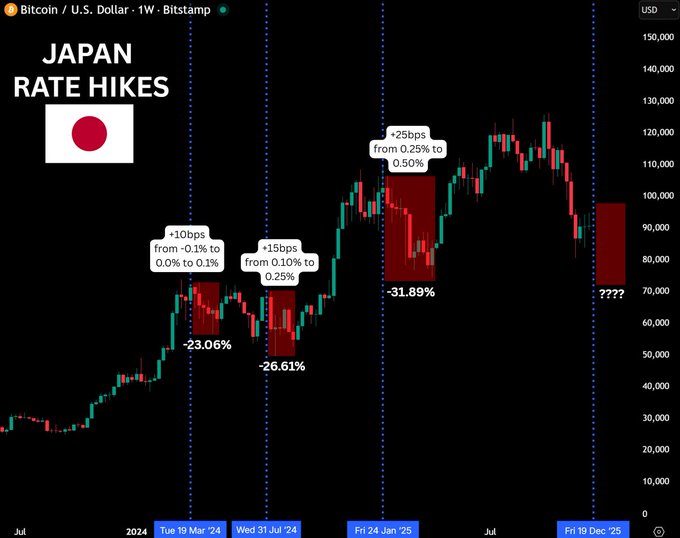
The Bank of Japan is widely expected to raise its policy rate by 25 basis points on December 19, 2025, moving it from 0.50% to 0.75%. While modest by global standards, such a move carries outsized implications for risk assets — including cryptocurrencies — due to its impact on global liquidity.
At the core of this dynamic is the yen carry trade.
For decades, Japan’s ultra-low interest rates allowed investors to borrow yen cheaply and deploy that capital into higher-yielding assets abroad. Bitcoin, Ethereum, equities, and other speculative instruments benefited significantly from this flow of cheap liquidity.
When Japanese rates rise, however, borrowing in yen becomes more expensive. Investors are often forced to unwind these trades by repaying loans, which typically involves selling risk assets. This process can trigger sharp price declines, forced liquidations, and a broader tightening of financial conditions — all of which tend to weigh heavily on crypto markets.
Historical Trends Point to Elevated Downside Risk
History offers several cautionary examples of how Bitcoin has reacted to past Bank of Japan tightening cycles.
- March 2024 rate hike: Bitcoin declined approximately 23%
- July 2024 rate hike: BTC fell around 26%
- January 2025 rate hike: Bitcoin dropped roughly 30–31%
Each of these episodes followed a similar pattern: yen strength, reduced global liquidity, and accelerated selling across speculative assets. Analysts tracking macro-crypto correlations note that the consistency of these drawdowns has made Japanese monetary policy an increasingly important risk variable for digital assets.
 Credits: @coinbureau (X)
Current Market Context: Already on Shaky Ground
As of December 18, 2025, Bitcoin is trading between $86,000 and $89,000, well below its earlier 2025 highs near $92,000–$120,000. Much of this weakness appears tied to anticipatory positioning, as traders have begun unwinding leverage ahead of the expected policy shift.
Markets are currently pricing in a 90–98.5% probability of a rate hike, contributing to choppy, directionless trading throughout December. Early warning signals have already emerged. Rising Japanese government bond (JGB) yields earlier this month coincided with BTC briefly slipping below $86,000, triggering billions of dollars in liquidations across crypto derivatives markets.
 Source: @Derago777 (X)
What Could Happen Next?
Most analysts expect heightened volatility immediately following the December 19 announcement and Governor Kazuo Ueda’s press conference.
In the bearish scenario, a deeper carry trade unwind could push Bitcoin into a 20–30% correction, potentially driving prices below $70,000.
Altcoins and Ethereum could experience even sharper moves, given their higher leverage sensitivity and thinner liquidity. A stronger yen, falling USD/JPY, and spillover weakness from equities and FX markets could further amplify downside pressure.
Are There Any Offsetting Factors?
Despite the risks, not all analysts expect a repeat of prior drawdowns.
One mitigating factor is that the rate hike is largely priced in, unlike earlier episodes that caught markets off guard. Additionally, the Bank of Japan’s gradual approach to normalization may help limit shock effects.
External factors could also help cushion the blow. The U.S. Federal Reserve’s accommodative stance in 2025, including rate cuts and liquidity support, may partially offset tightening from Japan. From a longer-term perspective, some investors see any post-hike weakness as a potential accumulation opportunity, especially if global liquidity conditions improve in 2026.
Bottom Line
While long-term crypto fundamentals remain intact, the short-term outlook is cautious. Historical trends suggest that Japanese rate hikes have consistently coincided with meaningful Bitcoin drawdowns, and current market positioning leaves little room for complacency.
As the December 19 decision approaches, traders will be watching USD/JPY movements, funding rates, and liquidation data closely for real-time signals. For now, macro forces — particularly Japanese monetary policy — remain one of the most significant risk factors shaping crypto markets into year-end.