
WhatsApp’s largest user base is now presenting its greatest challenge
WhatsApp Faces Major Changes Amid New Indian Regulations
WhatsApp, the popular messaging platform owned by Meta and used by millions across India, is at a pivotal crossroads as new government directives threaten to alter the way both individuals and businesses interact with the app.
Last month, Indian authorities issued new guidelines—publicly disclosed earlier this month—requiring certain messaging services to keep user accounts constantly connected to an active SIM card. These rules also introduce tighter restrictions on how these apps operate across multiple devices.
The Indian government claims these steps are necessary to combat the surge in cybercrime in the country, which is now the most populous in the world. However, digital rights advocates, policy analysts, and industry representatives—including those from Meta—have cautioned that such measures could lead to excessive regulation and disrupt legitimate activities. This is particularly concerning in India, where WhatsApp has become an essential tool for daily communication and small business operations.
Under the new rules, which must be implemented by companies like Meta, Telegram, and Signal within 90 days of November 28, messaging apps must remain linked to the SIM card used during registration. Additionally, users accessing these services via web or desktop clients will be required to log out every six hours and reconnect their devices using a QR code.
According to a recent press release from the telecom ministry, “Continuous SIM-device association and regular logouts ensure that every active account and web session is tied to a verified, live SIM card, making it easier to trace numbers involved in scams such as phishing, investment fraud, digital arrests, and fraudulent loans.” The ministry also revealed that cyber fraud losses in India have surpassed ₹228 billion (approximately $2.5 billion) in 2024 alone.
The government has clarified that these requirements do not apply if the SIM card remains in the device and the user is roaming.
While these directives affect all major instant messaging platforms, WhatsApp is expected to be the most impacted, given its massive user base of over 500 million in India. The app’s penetration is remarkable: in November, 94% of Indian WhatsApp users accessed the app daily, and 67% of WhatsApp Business users did the same, according to Sensor Tower data. In contrast, only 59% of U.S. WhatsApp users and 57% of U.S. WhatsApp Business users opened the app daily.
Many small businesses in India depend on WhatsApp Business—a version of the app designed for entrepreneurs—by registering accounts on SIM-enabled phones and managing customer interactions through web or desktop clients on other devices. Unlike larger enterprises that use WhatsApp’s Business APIs for automated communications, these smaller merchants rely on the standard app and its web interface. The new SIM binding and frequent logouts could disrupt their workflows for handling orders, customer support, and engagement.
These regulatory changes come at a time when WhatsApp has been enhancing its multi-device features, allowing users and businesses to stay connected across various devices without needing a single active smartphone.
From Rapid Growth to Deep Integration
The new directives arrive as WhatsApp’s growth in India shifts from rapid user acquisition to focusing on retaining its existing user base, which is now its largest worldwide.
According to Sensor Tower, WhatsApp’s monthly active users on mobile in India have increased by 6% year-over-year in the current quarter, even as new downloads have dropped by nearly 49%. Compared to late 2022, active users have grown by 24%, while downloads have fallen by 14%.
“It’s reasonable to say that WhatsApp’s growth in India in recent years has been more about keeping current users engaged than attracting new ones,” said Abraham Yousef, a senior analyst at Sensor Tower.
Appfigures data shows that since early 2024, WhatsApp Business has consistently seen more first-time installations in India than the standard WhatsApp Messenger, highlighting the increasing importance of business users over general consumers.
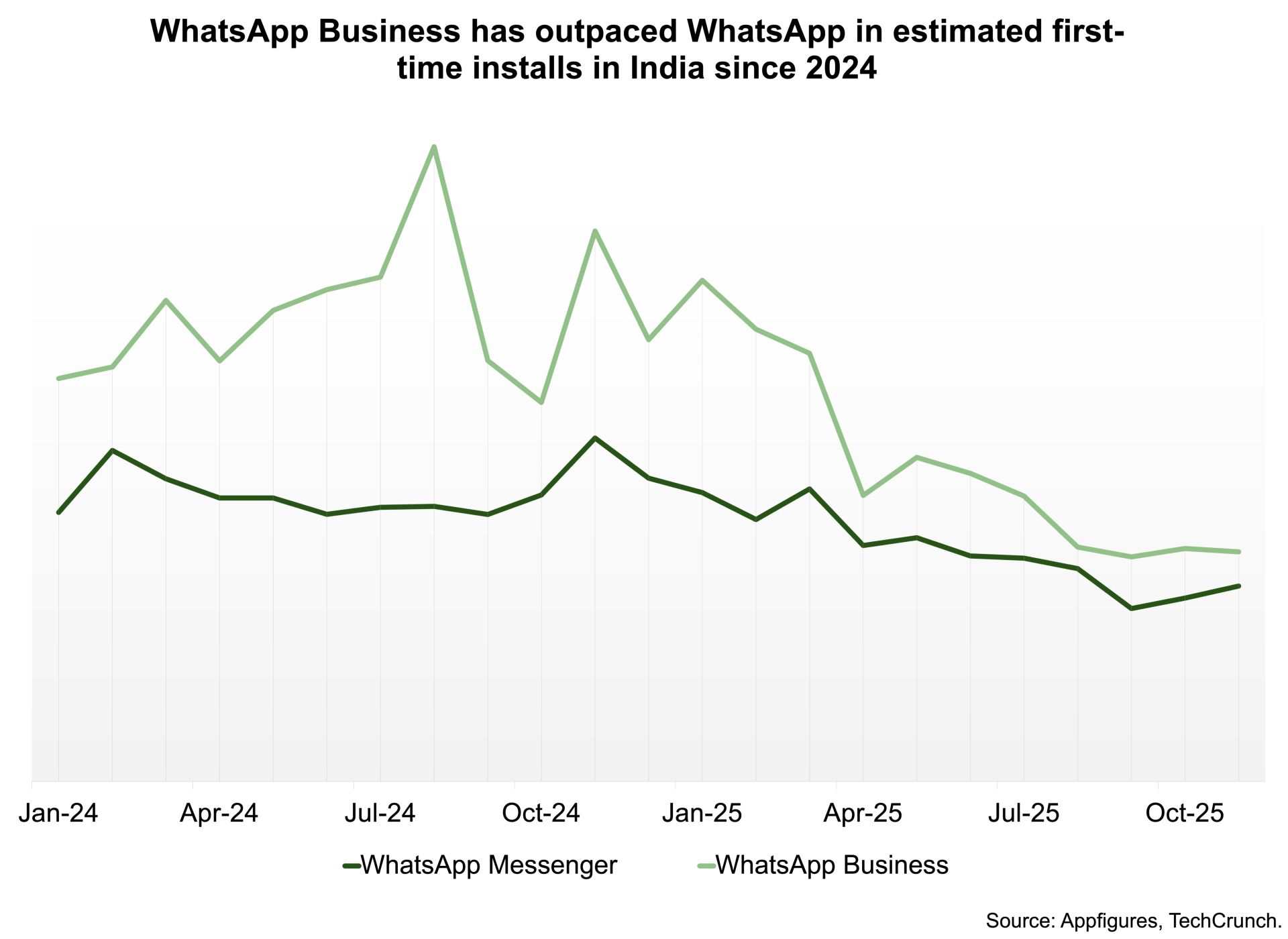
Image Credits: Jagmeet Singh / TechCrunch
Randy Nelson, head of insights at Appfigures, notes that this trend reflects how Indian merchants often use separate WhatsApp accounts for personal and business purposes, frequently utilizing dual-SIM phones. A single business may also install WhatsApp on multiple devices for staff use.
Sensor Tower’s figures support this, showing that WhatsApp Business’s monthly active users in India grew by over 130% from 2021 to late 2025, far outpacing the 34% growth seen by the standard WhatsApp Messenger during the same period.
Indian users remain highly engaged, spending an average of 38 minutes per day on WhatsApp in November, compared to 27 minutes on WhatsApp Business. In the U.S., the pattern is different, with users spending about 23 minutes daily on WhatsApp and 27 minutes on WhatsApp Business.
Technical and Legal Concerns Over New Rules
The Broadband India Forum (BIF), which counts Meta among its members, recently stated that the new requirements could cause “significant inconvenience and service interruptions for regular users,” and questioned whether the measures are technically feasible.
Kazim Rizvi, founder of the New Delhi-based think tank The Dialogue, explained that the new rules are based on a controversial reclassification of messaging apps as Telecommunication Identifier User Entities (TIUEs) under India’s telecom cybersecurity framework. This places messaging platforms under telecom regulations, rather than the IT Act, through executive orders instead of formal legislation.
“These directives are not grounded in statutory law but in delegated legislation,” Rizvi told TechCrunch. “The absence of public consultation or technical working groups could lead to compliance challenges without effectively tackling the root causes of fraud.”
The telecom ministry has not responded to requests for comment.
Currently, experts say companies like Meta have limited legal avenues to contest these directives in court. Dhruv Garg, a tech policy advisor, notes that challenging the rules would require proving they either exceed the legal framework or violate constitutional rights—an argument that may be difficult to sustain in this situation.
Meta declined to provide a statement regarding these developments.
Disclaimer: The content of this article solely reflects the author's opinion and does not represent the platform in any capacity. This article is not intended to serve as a reference for making investment decisions.
You may also like
The Influence of Academic Studies on Developing Technology Fields: How Educational Programs Foster Innovation and Attract Investment in AI, Engineering, and STEM
- Universities are integrating AI and engineering into STEM curricula to align with industry needs, fostering innovation and investment in education-aligned tech startups. - Farmingdale State College exemplifies academic-industry synergy through infrastructure investments like its $75M Computer Sciences Center, boosting workforce readiness and R&D in AI/cybersecurity. - Education-aligned startups like ELTUH leverage AI for infrastructure monitoring, while public-private partnerships in biotech and renewabl

The stablecoin market reaches a record $310.11 billion

Bitcoin (BTC) To Soar Higher? Key Pattern Formation Suggests Potential Upside Move

FARTCOIN to Rise Higher? Key Breakout and Retest Hint at a Potential Upside Move

Trending news
MoreCrypto prices
More





