
Trump signed an executive order to unify artificial intelligence regulations at the federal level.

on the 11th, U.S. President Trump signed an executive order to unify regulatory rules for the artificial intelligence sector at the federal level, restricting states from formulating their own rules. The executive order states that to achieve victory, American AI companies must be able to innovate freely without being burdened by cumbersome regulations, but "excessive state-level regulation" hinders this goal. The executive order points out that the current situation where states separately formulate regulatory rules will inevitably result in a patchwork of 50 different regulatory systems, making compliance more difficult, especially for startups. The executive order states that a "least burdensome" national standard will be established.
The executive order also requires the Attorney General to establish a special AI litigation task force whose "sole responsibility" is to challenge state AI laws that conflict with this executive order. Some U.S. tech companies have long opposed strict regulatory systems, and the latest executive order has been interpreted by some local media as a victory for these companies. Some media have pointed out that the latest policy may lead to weakened AI regulation, bringing risks. (Xinhua News Agency)
Disclaimer: The content of this article solely reflects the author's opinion and does not represent the platform in any capacity. This article is not intended to serve as a reference for making investment decisions.
You may also like
Investing in People: Maximizing Returns from Higher Education in a Tech-Focused Economy
- Higher education ROI is shifting as tech-driven economies prioritize vocational training for faster, lower-cost career pathways. - Certificate programs show short-term financial gains over bachelor's degrees, but long-term returns favor traditional degrees according to Utah Foundation data. - Corporations now treat human capital as a strategic asset, investing in AI-driven training to bridge skill gaps in emerging fields like cybersecurity. - Macroeconomic growth relies on aligning education with tech de
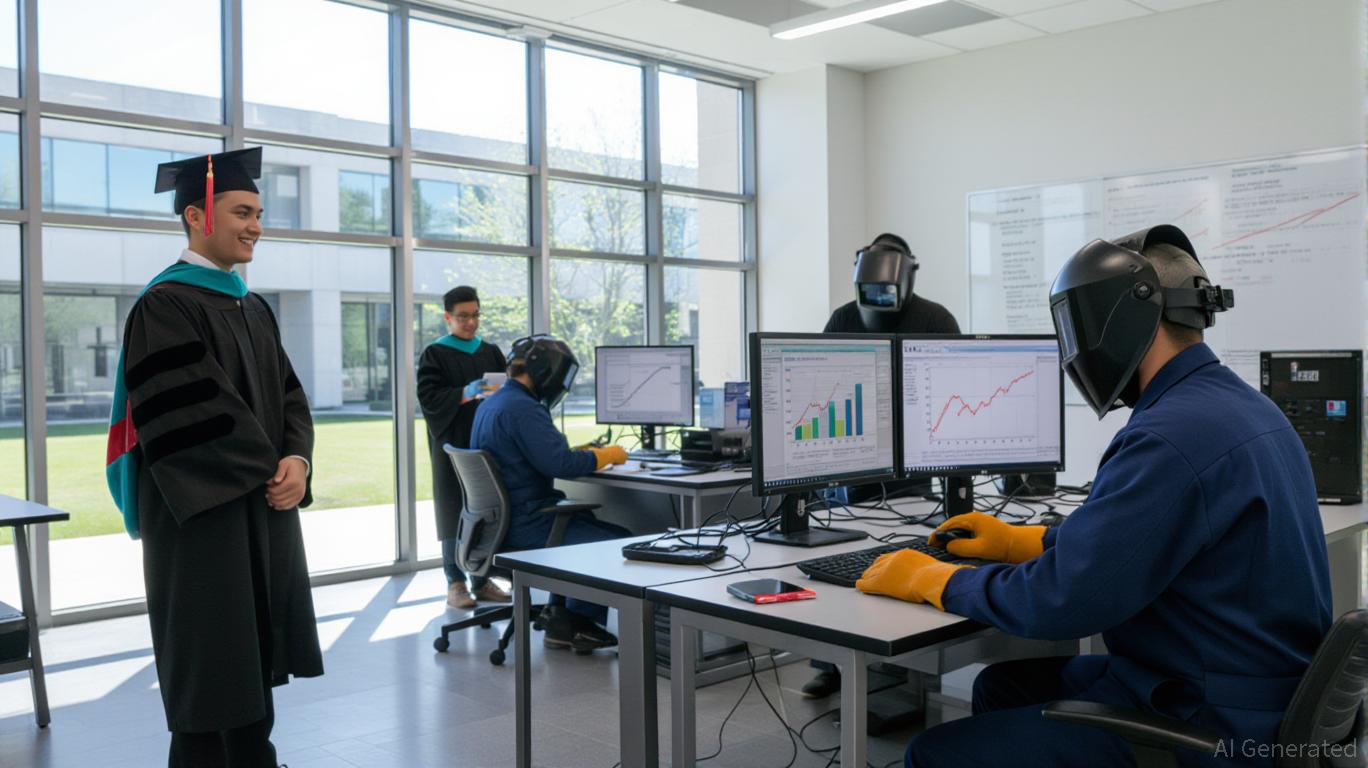
Evaluating the Expansion Opportunities for EdTech within STEM and Technical Disciplines
- Global EdTech market grows to $907.7B by 2034 as STEM workforce gaps drive demand for AI, cybersecurity, and engineering skills. - Traditional academic programs struggle with declining enrollments and outdated curricula, while private-sector EdTech fills gaps through AI/VR training tools. - Investors target ETFs like EDUT/VGT and startups like Protege, leveraging federal grants and industry-academia partnerships to address 3.5M cybersecurity job shortages. - Underfunded academic programs and policy shift

Hyperliquid (HYPE) Price Rally: Unpacking the Institutional Liquidity Transformation in DeFi
- Hyperliquid (HYPE) drove 2025 DeFi institutional adoption via HIP-3 upgrades, slashing fees 90% and boosting TVL to $2.15B. - Strategic partnerships with Anchorage Digital and USDH stablecoin integrations enhanced institutional confidence in HYPE's compliance and liquidity. - Deflationary tokenomics (97% fee buybacks) and $340M buyback programs stabilized HYPE amid November 2025 price drops to $27.43. - Macroeconomic risks and token unlocks challenge HYPE's momentum, but USDH auctions and $1B public offe

PEPE Holds Tight Range Near $0.054 as Support and Resistance Limit Price Movement

Trending news
MoreCrypto prices
More





