
Bitcoin’s Decline Triggers a Drop in GameStop Stock

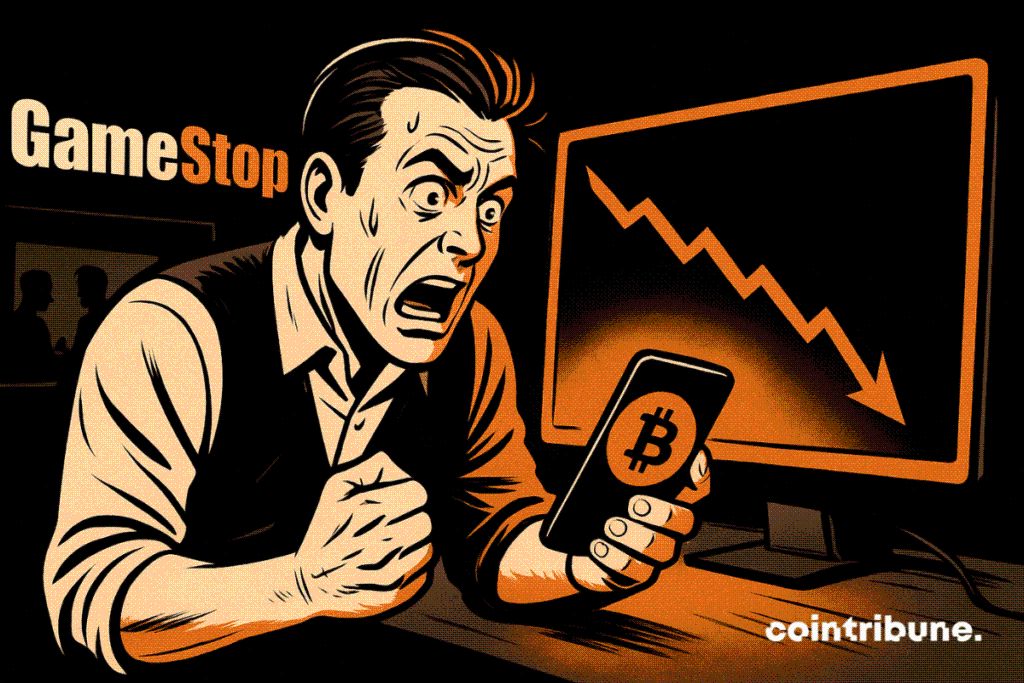
GameStop is going through a turbulent period after betting heavily on Bitcoin. The video game retailer sees its cryptocurrency holdings shrink by 9.2 million dollars in three months, causing its stock to fall by more than 5%. Faced with this setback, the company is now considering liquidating part of its digital assets.
In brief
- GameStop lost 9.2 million dollars on its 4,710 bitcoins during the third quarter of 2024.
- The company’s stock dropped 5.8% on Wednesday, falling below 24 dollars.
- The company plans to sell part of its bitcoins to limit losses.
- Corporate Bitcoin treasuries are taking a hard hit from the current crypto winter.
A risky bet that turns into a nightmare
GameStop had bet big last spring. Between May and June, the retailer acquired 4,710 bitcoins for 512 million dollars, financed by a 1.3 billion dollar bond issuance.
At the time, GameStop’s stock peaked at 35 dollars and Bitcoin seemed unstoppable. Six months later, the picture darkens seriously.
As of November 1st, the company’s bitcoin holdings were valued at 519.4 million dollars. An amount that still represents a gain of 19.4 million compared to the initial investment.
However, the trajectory is worrying. During the third quarter alone, the company incurred an unrealized loss of 9.2 million dollars. Bitcoin dropped from over 122,000 dollars to about 110,000 dollars in October before plunging to 90,000 dollars by mid-December.
If GameStop had sold at the historic high of 123,000 dollars, it would have pocketed a 12% profit. Today, Bitcoin shows a decrease of 2.7% since the initial purchase on May 28.
The company finds itself trapped in an uncomfortable position : keep and hope for a rebound, or sell at a loss to limit the hemorrhage. In its latest financial report, GameStop hinted it might opt for the latter solution.
GME stock reflects this uncertainty. From 35 dollars in May, it plunged 30% to reach 23.35 dollars just before the earnings release. The drop even accelerated Wednesday with an additional 5.8% decline. Investors clearly punish the company’s Bitcoin strategy.
Mixed results in a cold crypto market
The third quarter report reveals a mixed picture. Net sales stood at 821 million dollars, far from the 987 million expected by analysts. That’s 4.6% less than a year earlier and a 16.8% gap from forecasts. Revenue disappoints, but other indicators offer some hope.
Net profit soared to 77.1 million dollars, compared to only 17.4 million a year earlier. EBITDA literally exploded with a 675% growth, reaching 64.4 million dollars.
Operating margin turned positive at 5%, whereas it was -2.9% the previous year. These operational performances show that GameStop is improving its efficiency, even if sales stagnate.
But these good news struggle to offset the concern around bitcoin. GameStop is not the only company affected by the “crypto winter.” Companies that have built Bitcoin treasuries are all weathering the same storm.
Metaplanet , the second-largest publicly traded Bitcoin treasury, went from 600 million of unrealized gains at the beginning of October to 530 million in losses by December 1st, according to Galaxy Research.
This cold wave follows the massive liquidation on October 10th, described as “maximum pain” in crypto history. In one day, 19 billion dollars of positions were liquidated. Bitcoin lost 21% in 90 days, falling from 115,500 to 90,131 dollars.
The uncertain future of corporate Bitcoin treasuries
GameStop is now at a crossroads. Liquidating its bitcoins now would crystallize losses but secure the treasury. Keeping could pay off if bitcoin rebounds during the traditional year-end rally. A risky bet in a market that remains bearish.
With a market cap of 10.46 billion dollars, GameStop will have to decide quickly on the fate of its bitcoins. The video game retailer now embodies the risks of the crypto bet: between promises of profits and ruthless volatility, the balance remains precarious. Investors are watching every move closely.
Disclaimer: The content of this article solely reflects the author's opinion and does not represent the platform in any capacity. This article is not intended to serve as a reference for making investment decisions.
You may also like
The Financial Wellness Factor: An Overlooked Driver of Sustainable Wealth Building
- Financial wellness combines objective financial health and subjective well-being to drive long-term wealth creation, beyond mere asset accumulation. - Behavioral traits like conscientiousness correlate with disciplined investing habits, while neuroticism increases impulsive decisions during market volatility. - Studies show financially literate investors maintain portfolios during downturns, with 38% of "content" quadrant participants achieving superior risk-adjusted returns. - Debt management and saving

Aster DEX’s Latest Protocol Update and What It Means for DeFi Liquidity Providers
- Aster DEX's v2 upgrade enhances capital efficiency and privacy for liquidity providers (LPs) through ASTER token collateral and leveraged trading features. - The "Trade & Earn" functionality boosted TVL to $2.18B by November 2025, leveraging yield-bearing assets as trading margin. - However, 300x leverage and reduced tick sizes increase liquidation risks during volatility, while fee stagnation below $20M contrasts with $2B daily trading volumes. - Upcoming Aster Chain's privacy tools aim to attract insti
PEPE Steadies at $0.054711 With Narrow Range Shaping Short-Term Outlook

PEPE Maintains Structured Movement After 2.8% Gain as Analysts Watch Narrow Range

Trending news
MoreCrypto prices
More





