
Proposed ‘AfterDark’ Bitcoin ETF Would Skip U.S. Trading Hours

Weary U.S.-based bitcoin BTC$93.110,27 bulls might think it's their imagination that they seem to wake up every morning to BTC doing pretty well only for prices to head lower during the U.S. trading session.
They are, in fact, not imagining things.
Data from crypto analytics platform Velo.xyz shows that over the past year, bitcoin is more likely to be in the green when traditional U.S. markets are closed and in the red when they're open.
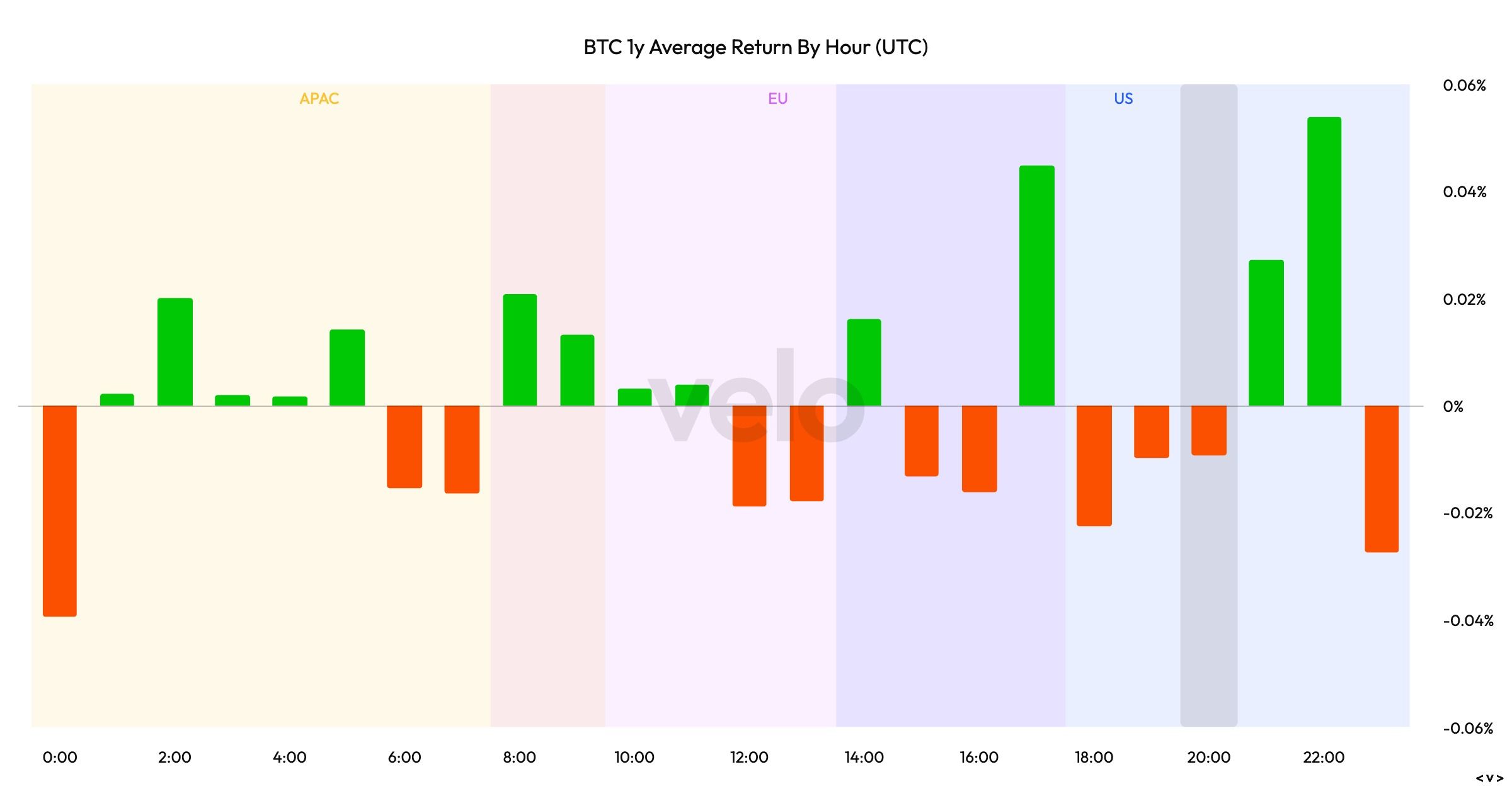
Bloomberg's Eric Balchunas said the data on better performance after U.S. hours was similar for 2024 as well and suggests the spot ETFs or derivatives positioning could be having an impact.
Seeking to take advantage, Nicholas Financial Corporation, a boutique wealth management firm, has filed with the U.S. Securities and Exchange Commission (SEC) to launch a bitcoin BTC$93.110,27 ETF that holds the asset only during overnight hours, opting out of the U.S. trading day entirely.
The fund, called the Nicholas Bitcoin and Treasuries AfterDark ETF (NGTH), would buy bitcoin at 4 p.m. ET—when U.S. markets close—and sell by 9:30 a.m. ET the following day, before the markets reopen. During daytime hours, the fund would rotate into short-term U.S. Treasuries to preserve capital and generate yield.
The firm also submitted paperwork for a second product, the Nicholas Bitcoin Tail ETF (BHGD).
If approved, the ETF would add a novel twist to the growing ecosystem of bitcoin investment products by treating time of day as a key factor in its strategy.
Disclaimer: The content of this article solely reflects the author's opinion and does not represent the platform in any capacity. This article is not intended to serve as a reference for making investment decisions.
You may also like
Key Bitcoin price levels to watch ahead of 2025’s last FOMC meeting

Navigating the Fluctuations of Bitcoin in Late 2025: Adaptive Risk Management Approaches for an Evolving Cryptocurrency Landscape
- Bitcoin's November 2025 price swung between $80,553 and $91,000, eroding 25% of value amid macroeconomic and regulatory pressures. - Volatility stemmed from technical breakdowns, leveraged liquidations, and market makers' gamma exposure shifts below $85,000. - U.S. GENIUS Act and EU MiCA framework provided regulatory clarity, boosting institutional adoption through compliant ETPs and stablecoins. - Investors adopted risk-rebalance strategies: options hedging, macro-adjusted DCA, and diversified crypto tr

Bitcoin Experiences Steep Drop: What Causes the Sudden Sell-Off?
- Bitcoin plummeted 30% in November 2025, erasing $1 trillion in market cap amid macroeconomic pressures and institutional profit-taking. - Central bank uncertainty (Fed, ECB) and leveraged liquidations amplified the selloff, with ETF outflows exceeding $3.79 billion. - Bitcoin's 0.90 correlation with the S&P 500 highlighted its shift from "digital gold" to risk-on asset, contrasting gold's 55% surge. - On-chain metrics revealed structural weaknesses: hash rate declines, miner revenue drops, and divergent

PENGU USDT Sell Alert and Stablecoin Price Fluctuations: Evaluating Algorithmic Dangers Amid Changing Cryptocurrency Markets
- PENGU USDT's 2025 volatility reignited debates on algorithmic stablecoin fragility amid regulatory uncertainty and post-UST market skepticism. - Technical analysis showed conflicting signals: overbought MFI vs bearish RSI divergence, with critical support/resistance levels at $0.010-$0.013. - $66.6M team wallet outflows and 32% open interest growth highlighted liquidity risks, while UST's collapse legacy exposed algorithmic design flaws. - Investors increasingly favor fiat-backed alternatives like USDC ,

Trending news
MoreCrypto prices
More





