Source: Wallstreetcn
As the “first domestic GPU stock,” Moore Threads’ debut on the STAR Market ignited market enthusiasm with an astonishing increase, which not only directly affirms its technological scarcity but also highlights the market’s strong optimism for the prospects of domestic high-end computing chips amid the artificial intelligence wave.
On December 5, Moore Threads officially landed on the STAR Market, opening at 650 yuan, a surge of 468.78% compared to its issue price of 114.28 yuan. During trading, the price peaked at 688 yuan, an increase of 502%, with its market value once exceeding 270 billions yuan. Calculated at the opening price, investors who got one lot (500 shares) made a floating profit of over 280,000 yuan, making it one of the most profitable new stocks this year. As of press time, the latest price was 590.59 yuan/share, an increase of 416.79%.
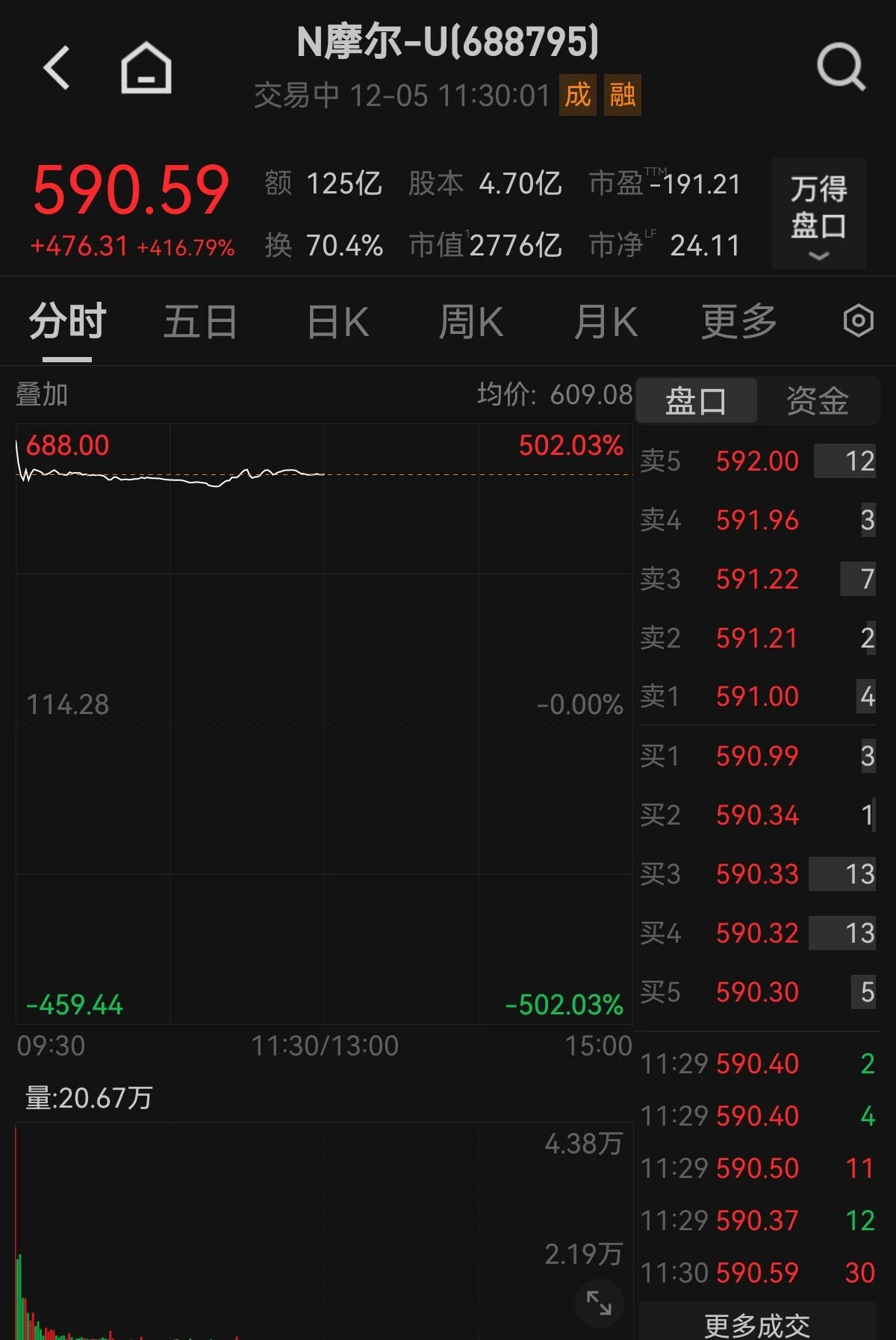
Moore Threads also brought astonishing returns to early investors— as one of the earliest investors, Peixian Qianyao’s initial investment achieved more than 6,262 times book value appreciation, creating a capital legend.
This IPO attracted 267 institutions to participate in the bidding, with an offline subscription multiple of 1,572 times. Leading institutions such as Southern Fund and E Fund used hundreds of products to apply. The company raised about 8 billions yuan, making it the largest IPO on the STAR Market this year. Although the company is still in a loss-making state, its price-to-sales ratio of 122 times far exceeds overseas giants such as Nvidia, showing that the market is pricing in a high premium for its future growth potential and technological uniqueness.
As the only domestic company capable of benchmarking Nvidia in terms of functionality, Moore Threads, based on its self-developed MUSA architecture, has achieved technological breakthroughs in AI computing, graphics rendering, physical simulation, and video encoding/decoding on a single chip. The company expects to achieve profitability as early as 2027, and it took only 158 days from submitting its application to listing, demonstrating the “STAR Market acceleration.”
Moore Threads’ founder, chairman, and general manager Zhang Jianzhong stated that the company will maintain an annual iteration speed for its full-featured GPU chips, aiming to build a comprehensive computing platform covering both cloud and edge scenarios. He emphasized that as long as AI continues to evolve, the demand for computing power will never be a bubble.
The “Scarce Target” Favored by Institutions
Moore Threads demonstrated extremely high enthusiasm from institutional investors during the initial inquiry phase. According to the issuance announcement, a total of 267 offline investors submitted valid bids, with 7,555 managed placement objects and a valid subscription volume of 70.406 billions shares. The offline subscription multiple reached 1,572 times, far exceeding the inquiry multiples of most new stocks this year.
The participating institutions were impressive: 86 public funds, 124 private funds, 30 securities firms, and 13 insurance institutions all appeared in the bidding queue. Among them, Southern Fund used 404 products to apply, with a total intended subscription of 5.285 billions shares; E Fund applied with 389 products; ICBC Credit Suisse and Fullgoal Fund applied with 345 and 265 products, respectively.
The preliminary online winning rate for Moore Threads’ issuance was 0.02423369%. When subscriptions opened on November 24, the issue price of 114.28 yuan/share set the highest record for new stock issuance prices this year. This IPO raised about 8 billions yuan, making it the largest IPO project on the STAR Market this year.
The company took only 158 days from submitting its STAR Market IPO application on June 30 to listing on December 5. As the only domestic GPU manufacturer with deep layouts in both B-end and C-end markets, Moore Threads has become an “irreplicable scarce target” in the eyes of the capital market.
Early Investors Earned 6,200 Times Returns
Since its founding in 2020, Moore Threads quickly became a focal point in the primary market. The company advanced its financing at an astonishing pace, with a cumulative scale exceeding 10 billions yuan and as many as 86 shareholders before listing.
Its fundraising ability is not only reflected in the total amount raised but also in the astonishing returns brought to early investors— as one of the earliest investors, Peixian Qianyao’s initial investment achieved more than 6,262 times book value appreciation, creating a capital legend.
The birth of Moore Threads coincided with the investment boom in the domestic semiconductor sector in 2020, with many strong players in the GPU track. Despite fierce competition, Moore Threads, dubbed the “Chinese Nvidia,” made a stunning debut, completing two rounds of financing in less than 100 days after its establishment, with a valuation exceeding 1 billion USD, setting a new industry record for the fastest unicorn, and demonstrating strong market appeal and development potential.
After gaining preliminary market recognition, Moore Threads completely ignited the enthusiasm of the capital market. From the Pre-A round in 2021 to the A round, the company attracted dozens of top institutions such as Shenzhen Capital Group, Sequoia China, GGV Capital, ByteDance, and Guosheng Capital for “group buying” style investments. This grand occasion shows that both long-established institutions deeply rooted in the sector and cross-industry industrial capital regard Moore Threads as a leading target not to be missed, rushing in and jointly promoting its rapid development.
Profitability Challenges Under High Valuation
Despite the market’s enthusiasm, the company is still in a state of continuous loss. Moore Threads’ revenue in 2024 was 438 millions yuan, with a net loss of 1.618 billions yuan, and a price-to-sales ratio of 122 times, far exceeding overseas GPU giants such as Nvidia.
The company’s revenue has risen rapidly in recent years, from 46.088 millions yuan in 2022 to 438 millions yuan in 2024, and revenue of 785 millions yuan has already been achieved in the first three quarters of 2025. However, due to huge R&D investment, net profits from 2022 to 2024 were losses of 1.894 billions, 1.703 billions, and 1.618 billions yuan, respectively. In the first three quarters of 2025, the loss was 724 millions yuan, with a single-quarter loss of 453 millions yuan in the third quarter, an increase of nearly 180 millions yuan year-on-year.
R&D expenses remain high, with investments of 1.116 billions, 1.334 billions, and 1.359 billions yuan from 2022 to 2024, and 557 millions yuan in the first half of 2025. The company’s R&D expenses have long exceeded its operating income, reflecting its emphasis on technological R&D. Moore Threads expects to achieve consolidated profitability as early as 2027, which means that domestic GPU companies still need to endure a relatively long incubation period.
“Full-Function GPU” Benchmarking Nvidia
“Moore Threads is the definer of full-function GPUs.” Zhang Jianzhong explained that, unlike other domestic GPU companies, Moore Threads’ products are “full-function GPUs.” Based on its self-developed MUSA architecture, the company took the lead in achieving breakthroughs in supporting AI computing acceleration, graphics rendering, physical simulation, and ultra-high-definition video processing capabilities on a single chip architecture.
Zhang Jianzhong introduced that as humanity enters the intelligent era, the demand for computing platforms in scientific research is breaking boundaries. A scientist may need AI model training, high-performance computing, 3D graphics rendering, video encoding/decoding, and physical simulation platforms simultaneously during work. Moore Threads is committed to building a general-purpose computing acceleration platform, using computing to open up new ideas for scientific research and explore more AI application scenarios.
The MUSA architecture is compatible with the international mainstream GPU ecosystem dominated by Nvidia, enabling developers to fully utilize their existing code resources in the current international mainstream ecosystem at a lower cost. This makes Moore Threads the only domestic company capable of benchmarking Nvidia in terms of functionality, and it is also known as the Chinese Nvidia.
Three Major Fundraising Projects Covering All Scenarios
This IPO of Moore Threads will fund three major projects: the AI training and inference integrated chip project aims to build an intelligent computing platform integrating computing, storage, and communication, which can meet the needs of clusters with tens of thousands or even hundreds of thousands of cards in the future; the new generation of independently controllable graphics chips will meet 3D rendering and related needs, such as digital twins and simulation of the physical world; the AI SoC chip project aims to meet the needs of intelligent agents in the Internet of Everything, that is, to meet edge-side AI requirements.
“Based on the iteration of the MUSA architecture, we will build a full-scenario computing platform covering both cloud and edge, providing strong AI computing support for the digital and intelligent transformation of various industries,” said Zhang Jianzhong. Since its establishment in 2020, the company has always focused on the independent R&D and design of full-function GPUs.
According to Frost & Sullivan, the global GPU market size will reach 3.62 trillions yuan by 2029. Among them, the Chinese market is growing particularly rapidly, with a scale expected to reach 1.36 trillions yuan, and its global share will increase from 15.6% in 2024 to 37.8%, with a compound annual growth rate as high as 51.1%. Zhang Jianzhong believes, “Human society has entered the computing era, computing power is national power, and GPU chips have become the cornerstone of computing power.”