
World Liberty Financial Unveils 8.4 Million WLFI Token Airdrop Amid Price Slump

World Liberty Financial’s $1.2 million WLFI airdrop rewards early USD1 adopters, but with prices down and sentiment weak, question arises whether the giveaway will boost confidence or add selling pressure.
World Liberty Financial, the decentralized finance (DeFi) venture backed by US President Donald Trump, announced that it will distribute about $1.2 million worth of WLFI tokens to early users of its USD1 points program.
This airdrop arrives as WLFI faces a challenging market, with prices falling 24.6% since September and bearish sentiment prevailing among traders.
WLFI Airdrop Targets Early Supporters of USD1 Program
According to the official statement, six centralized exchanges (CEXs) will oversee the distribution of 8.4 million WLFI tokens to eligible users. Rewards will go to participants who earned points by trading with USD1 pairs and holding USD1 balances.
The first phase of distribution will be carried out by Gate, KuCoin, LBank, HTX, Flipster, and MEXC. World Liberty Financial advised users to check announcements from their respective exchanges for details on reward allocation and distribution schedules.
“The criteria and eligibility for earning points and rewards and distribution details may vary based on each exchange’s rules,” the team noted.
World Liberty said the airdrop recognizes users who played a key role in expanding the adoption of USD1. According to CoinGecko, USD1 is ranked among the top 10 stablecoins by market capitalization. Thus, the initiative rewards community loyalty while encouraging continued use of USD1 across participating platforms.
“Two months ago, World Liberty launched the USD1 Points Program to Select Exchanges. The Loyalty platform put power in the hands of early users, who helped drive $500m of growth in the last two months through activities such as purchasing and using USD1 on partner exchanges. Now, those users get rewarded,” the post read.
The DeFi project emphasized that the latest reward distribution marks the beginning of a broader expansion plan for the WLFI and USD1 ecosystem. World Liberty added that,
“The WLFI points program will continue expanding alongside new USD1 initiatives, with more venues and ways to earn points, new trading pairs and ways to use USD1, upcoming DeFi integrations, and broader reward opportunities for driving use and adoption.”
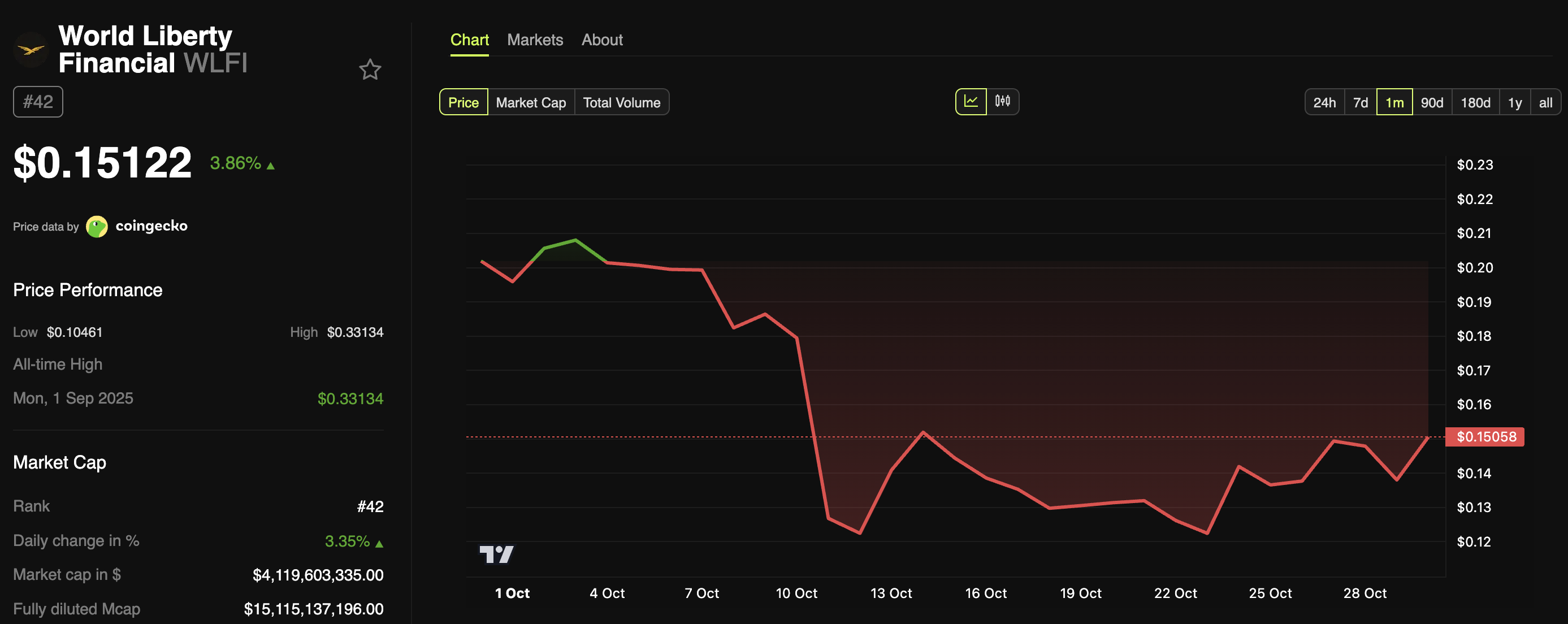
Meanwhile, as the community prepares for the much-anticipated WLFI airdrop, the token itself is showing a modest recovery. According to BeInCrypto Markets data, WLFI has seen a 3.86% increase over the past 24 hours. At press time, the altcoin was trading at $0.151.
 WLFI Token Price Performance. Source:
BeInCrypto Markets
WLFI Token Price Performance. Source:
BeInCrypto Markets
However, the recent uptick remains minor compared to the WLFI’s broader downtrend. Despite debuting on major exchanges, the token has faced market challenges.
Since launching, WLFI has lost approximately 24.6% of its value. Sentiment indicators reflect this lingering pessimism — data from CoinGecko shows that around 60% of traders remain bearish on the token.
While the upcoming airdrop has reignited community excitement, it could also be a double-edged sword for WLFI’s short-term performance. Airdrops often trigger short-term selling as recipients cash in their free tokens. Moreover, it increases the circulating supply, which, without a matching rise in demand, can lead to further price drops.
The timing, amid a market downturn, increases uncertainty. Whether this distribution pushes WLFI lower or renews interest depends on broader trends and recipient behavior in the weeks ahead.
Disclaimer: The content of this article solely reflects the author's opinion and does not represent the platform in any capacity. This article is not intended to serve as a reference for making investment decisions.
You may also like
U.S. Marine Policy and Blue Economy Prospects: Key Infrastructure and Geostrategic Roles in Oceanic Commerce
- U.S. oceans policy balances geopolitical strategy, deep-sea tech investments, and UNCLOS ratification challenges to secure maritime influence. - Executive actions accelerate seabed mineral extraction while facing environmental criticism and legal risks from bypassing international seabed authority rules. - Offshore energy partnerships with Australia, Japan, and Saudi Arabia aim to diversify supply chains but face geopolitical tensions in chokepoints like the Red Sea. - Maritime security contracts expand

Aster DEX's On-Chain Momentum: Signaling the Future of DeFi
- Aster DEX reported $27.7B daily volume and $1.399B TVL in Q3 2025, outpacing DeFi benchmarks with 2M users. - Institutional whale activity, including CZ's $2M ASTER purchase, drove $5.7B inflows and 800% volume spikes. - Hybrid AMM-CEX model and ZKP privacy tech enabled 40.2% TVL growth, 77% private transactions, and 19.3% perpetual DEX market share. - ASTER's margin trading upgrades and Stage 4 airdrops fueled 30% price surges, while Aster Chain's 2026 launch will integrate privacy-preserving ZKPs. - On
Astar (ASTR) Price Rally: Protocol Enhancements and Ecosystem Growth Drive Long-Term Value
- Astar (ASTR) surged 150% due to protocol upgrades and ecosystem expansion, positioning it as a sustainable value creation case study in blockchain. - Tokenomics 3.0 (fixed 10.5B supply) and Burndrop mechanism created deflationary incentives, supported by Galaxy Digital's $3. 3M OTC investment and Astar's $29.15M buyback. - Cross-chain interoperability with Polkadot/Plaza and Sony's Soneium, plus partnerships with Toyota and Japan Airlines, expanded real-world utility in logistics, identity, and loyalty p

Astar 2.0 Debut and Tokenomics Revamp: Driving DeFi Innovation and Attracting Institutional Participation
- Astar Network's Astar 2.0 introduces Tokenomics 3.0 with fixed 10.5B ASTR supply and 5% annual burn rate to stabilize value for institutional investors. - The update features Burndrop mechanism, asynchronous cross-chain security, and ESG-aligned protocols to address regulatory risks and attract traditional capital. - Plaza platform enables seamless asset transfers across Ethereum , BSC, and Polkadot , while zkEVM scalability targets 300,000 TPS by 2026 for enterprise-grade DeFi solutions. - Governance sh
Trending news
MoreCrypto prices
More





