
Prominent Ethereum developer Dankrad Feist departs EF to join stablecoin-focused Layer 1 Tempo

Quick Take Dankrad Feist, who has made several notable contributions to Ethereum since entering the ecosystem in 2018, is joining Tempo, the alternative Layer 1 incubated by Stripe and Paradigm. Several Ethereum community members have commented on the loss. In his announcement, Feist noted that Tempo and Ethereum are “strongly aligned” and “built with the same permissionless ideals in mind.”
Prominent Ethereum developer Dankrad Feist is joining Tempo, the alternative, payments-focused Layer 1 being developed by Stripe and Paradigm .
"While payments used to be front and center in the early days of crypto, I see a special opportunity to finally achieve this ambitious goal with relentless execution on both the technical and distribution fronts," Feist said in a statement on Friday.
Feist joined the Ethereum Foundation in 2018 as a part-time researcher and quickly rose in ranks. Perhaps most notably, Feist is known for co-creating the Danksharding sharding design to improve Layer 2 scalability.
Further, during the shakeup in the Ethereum Foundation's leadership earlier this year, Feist was named as a strategic advisor across areas like L1 scaling and UX. Feist was known for his ambitious goals of improving the largest smart contract blockchain, including proposals like EIP-9698 to increase Ethereum’s gas limit 100-fold .
Feist’s departure has been taken as a blow to many in the Ethereum ecosystem. Bankless co-founder David Hoffman, an ETH cheerleader, noted it is an "Incredible loss for Ethereum."
"Tempo is built on Ethereum tech and now stacked with former Ethereum OGs - people who loved Ethereum but became somewhat jaded for one reason or another," Ryan Sean Adams, another Bankless co-founder, said on X.
In late 2024, Feist and his EF colleague Justin Drake courted controversy when taking advisor positions at EigenLayer, which some deemed a possible conflict of interest. Both Feist and Drake later resigned and apologized, pledging to turn down future offers.
For his part, Feist noted that Tempo is a "great complement" to Ethereum and he plans to remain "involved with the community."
"Ethereum has a strong set of values and technical choices that make it unique in the world," Feist said. "Tempo’s open-source technology can easily integrate back into Ethereum, benefiting the entire ecosystem. Ethereum and Tempo are strongly aligned, as they are built with the same permissionless ideals in mind."
Tempo is an EVM-compatible Layer 1 "optimized for high-scale, real-world financial services applications" for companies like Anthropic, Deutsche Bank, DoorDash, Nubank, OpenAI, Revolut, and Shopify, Stripe CEO Patrick Collison said when announcing the project.
"Dankrad has been an excellent researcher and has made immensely valuable contributions to the Ethereum that we know and love today, including Danksharding, consensus research, and much more. Wishing him luck in his new efforts," Ethereum creator Vitalik Buterin said.
Disclaimer: The content of this article solely reflects the author's opinion and does not represent the platform in any capacity. This article is not intended to serve as a reference for making investment decisions.
You may also like
Privacy Coins and Market Fluctuations: Uncovering the Factors Behind ZEC's Latest Price Jump
- Zcash (ZEC) surged 700% in late 2025 driven by institutional backing and network upgrades like the Zashi wallet. - Regulatory pressures and market fragmentation intensified as exchanges delisted privacy coins and liquidity shifted to decentralized platforms. - ZEC's volatility reflects macroeconomic tailwinds and speculative demand, but its long-term viability hinges on balancing privacy with regulatory compliance. - Institutional adoption of privacy coins accelerated in 2025, yet fragmented markets and

Why Dash (DASH) Is Soaring as Institutions Embrace It and Privacy Concerns Fuel Demand
- Dash (DASH) surged 150% in June 2025, driven by institutional adoption and privacy-focused demand. - Institutional ownership reached 90.64% after AGF Management's $7.79M investment and DoorDash's $450M partnership. - Dash Platform 2.0 enhanced scalability while PrivateSend usage grew 25% YoY amid rising privacy needs. - Regulatory challenges persist under EU MiCA and SEC scrutiny, prompting multi-jurisdictional compliance strategies. - DeFi integration and Latin American adoption expanded DASH's utility
ZK Atlas Upgrade: Pioneering the Future of Blockchain Infrastructure for Enhanced DeFi Scalability
- ZKsync's 2025 Atlas Upgrade revolutionizes DeFi scalability via zero-knowledge rollups, boosting transaction throughput to 43,000 TPS and slashing costs to $0.0001 per transfer. - Modular architecture with Atlas Sequencer and Airbender Prover enables real-time execution, while zkSync OS supports EVM/WASM compatibility and cross-chain liquidity unification. - Post-upgrade DeFi metrics show 300% transaction volume growth and $0.28–$1.32 ZK token price projections, positioning ZKsync as a key Layer 2 infras

Bloomberg: Power Theft Exceeds $1 Billion as Malaysia Bitcoin Mining Rigs Overwhelm
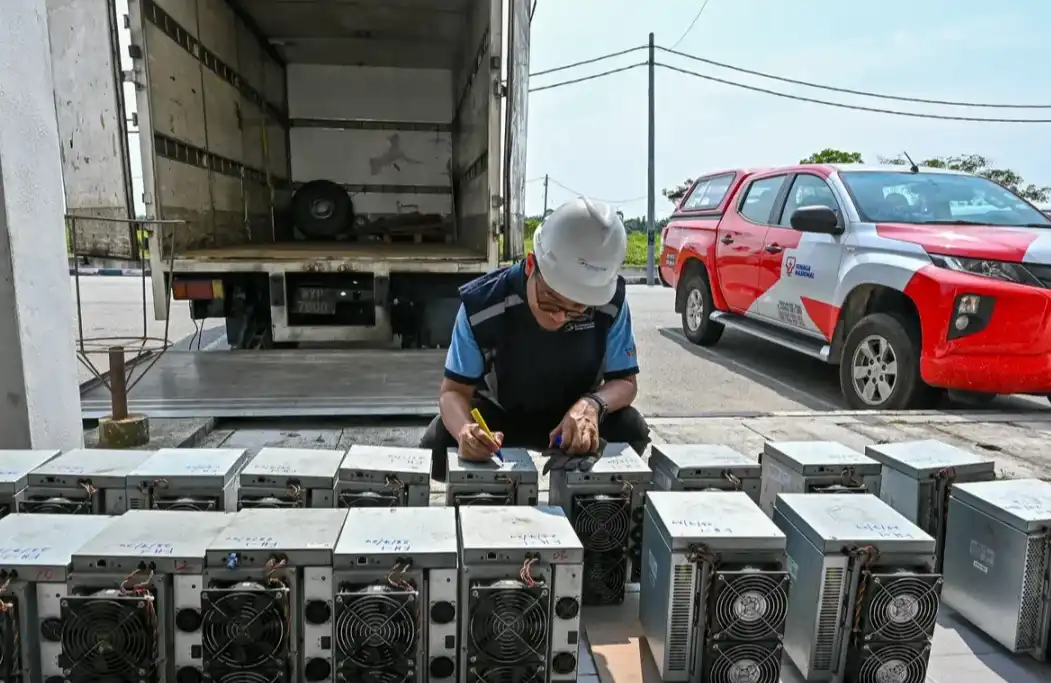
Malaysia has uncovered approximately 14,000 illegal cryptocurrency mining sites in the past five years, causing the state-owned power company losses of over $1.1 billion. In response, the local government established a special committee in November 2025 to consider a total ban on mining,
Trending news
MoreCrypto prices
More





