

As Ernest Hemingway wrote in The Sun Also Rises, “How did you go bankrupt? Two ways. Gradually, then suddenly.”
— Rep. Keith Self (@RepKeithSelf) October 3, 2025
The U.S. debt stands at $37 trillion, and is projected to hit $38 trillion in weeks and possibly $50 trillion within a decade.
Congress must act now—demand fiscal…
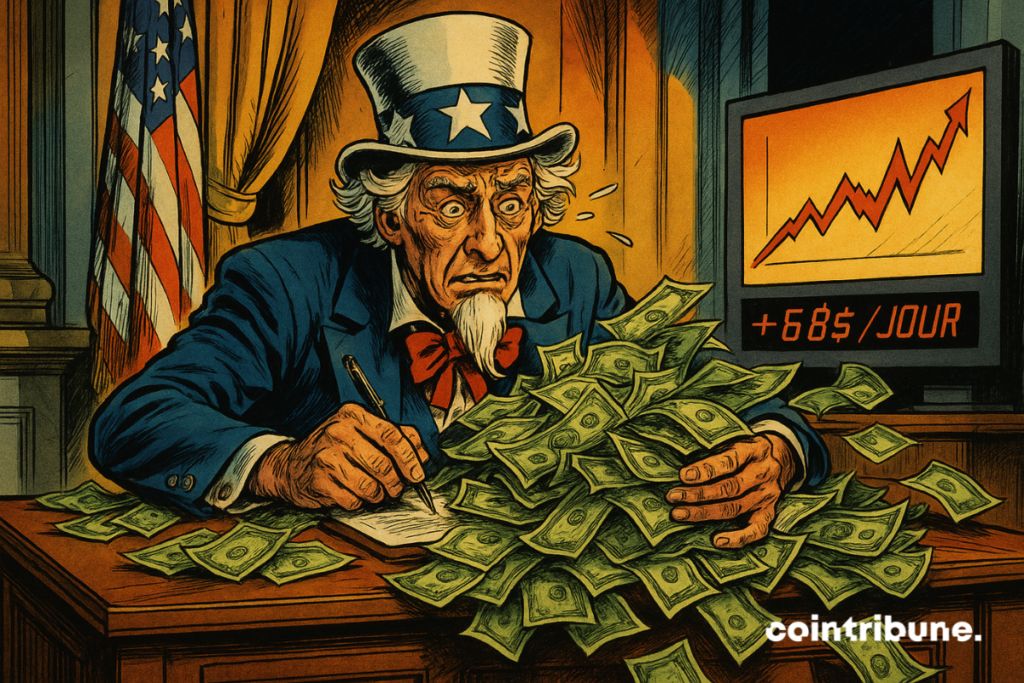
The United States Debt Climbs by 6 Billion Dollars Per Day
By:Cointribune
Summarize this article with:
ChatGPT Perplexity Grok
The United States debt is rushing toward 38 trillion dollars, triggering deep doubt about the solidity of fiat currencies. In a world where economic balances are shaky, this threshold is no longer just a macroeconomic indicator. It becomes the reveal of a system under strain, and revives the debate about the place of alternative assets in the face of the exhaustion of classic budgetary models.
A Budgetary Trajectory Out of Control
The U.S. federal debt has reached 37.9 trillion dollars and is expected to surpass 38 trillion in less than three weeks, according to data from the Joint Economic Committee of the U.S. Congress .
This pace of growth is particularly striking, as the debt increases by $69,890 per second, or 4.2 million per minute, which amounts to 6 billion dollars per day, a figure greater than the gross domestic product of more than thirty countries, according to Worldometer data .
U.S. Representative Keith Self has alerted on the severity of the situation stating: “Congress must act now, demand budgetary responsibility from your leaders before the gradual slide becomes a sudden collapse”.
Behind this dynamic, several factors illustrate the current inability of the U.S. government to curb the growth of public debt, despite budget rationalization efforts:
- In a few months, the Trump administration tasked Elon Musk with overseeing a spending reduction program via the Department of Government Efficiency, generating 214 billion dollars in savings;
- In July, Donald Trump signed the “One Big Beautiful Bill Act”, supposed to save 1.6 trillion dollars in federal spending;
- However, implementation of this law is expected to cost 3.4 trillion over the next ten years, paradoxically contributing to increasing the debt;
- Debt is expected to reach 50 trillion dollars within ten years if no structural changes are made, according to projections mentioned by Keith Self.
Thus, attempts at budget reforms, even ambitious on paper, seem ineffective in stopping the spiral of the United States debt.
Alternative Assets as a Response to Monetary Disorder
While debt explodes in the United States, investors are increasingly turning to assets seen as bulwarks against monetary depreciation. Last week, JPMorgan called bitcoin and gold preferred choices in a hedge strategy against currency value erosion, that is a direct response to the anticipated weakening of the dollar.
This market reading occurs in a context where bitcoin reached an all-time high of 125,506 dollars , while gold crossed a new record at 3,920 dollars. While these levels are unusual and to be verified over time, they nevertheless reflect a growing demand for alternative assets in the face of economic instability.
Major figures in institutional finance support this trend. Last January, Larry Fink, CEO of BlackRock and formerly skeptical about bitcoin, stated that crypto could rise to 700,000 dollars due to fears related to monetary devaluation.
Meanwhile, Ray Dalio, founder of Bridgewater Associates fund, recommended in July dedicating 15% of a portfolio to assets like gold or bitcoin to optimize the risk/return ratio. He highlights that Western countries, like the UK, are not immune to what he calls a “debt spiral”, thus reinforcing interest in safe haven assets.
The inexorable rise of American debt, dropped by China , gives renewed credit to decentralized assets like bitcoin. Between lost monetary trust and the search for refuges, markets are testing new benchmarks. The question remains whether these alternatives will sustainably impose themselves in a financial landscape undergoing reorganization.
0
0
Disclaimer: The content of this article solely reflects the author's opinion and does not represent the platform in any capacity. This article is not intended to serve as a reference for making investment decisions.
PoolX: Earn new token airdrops
Lock your assets and earn 10%+ APR
Lock now!
You may also like
U.S. Marine Policy and Blue Economy Prospects: Key Infrastructure and Geostrategic Roles in Oceanic Commerce
- U.S. oceans policy balances geopolitical strategy, deep-sea tech investments, and UNCLOS ratification challenges to secure maritime influence. - Executive actions accelerate seabed mineral extraction while facing environmental criticism and legal risks from bypassing international seabed authority rules. - Offshore energy partnerships with Australia, Japan, and Saudi Arabia aim to diversify supply chains but face geopolitical tensions in chokepoints like the Red Sea. - Maritime security contracts expand
Bitget-RWA•2025/12/11 12:28

Aster DEX's On-Chain Momentum: Signaling the Future of DeFi
- Aster DEX reported $27.7B daily volume and $1.399B TVL in Q3 2025, outpacing DeFi benchmarks with 2M users. - Institutional whale activity, including CZ's $2M ASTER purchase, drove $5.7B inflows and 800% volume spikes. - Hybrid AMM-CEX model and ZKP privacy tech enabled 40.2% TVL growth, 77% private transactions, and 19.3% perpetual DEX market share. - ASTER's margin trading upgrades and Stage 4 airdrops fueled 30% price surges, while Aster Chain's 2026 launch will integrate privacy-preserving ZKPs. - On
Bitget-RWA•2025/12/11 12:10
Astar (ASTR) Price Rally: Protocol Enhancements and Ecosystem Growth Drive Long-Term Value
- Astar (ASTR) surged 150% due to protocol upgrades and ecosystem expansion, positioning it as a sustainable value creation case study in blockchain. - Tokenomics 3.0 (fixed 10.5B supply) and Burndrop mechanism created deflationary incentives, supported by Galaxy Digital's $3. 3M OTC investment and Astar's $29.15M buyback. - Cross-chain interoperability with Polkadot/Plaza and Sony's Soneium, plus partnerships with Toyota and Japan Airlines, expanded real-world utility in logistics, identity, and loyalty p
Bitget-RWA•2025/12/11 11:56

Astar 2.0 Debut and Tokenomics Revamp: Driving DeFi Innovation and Attracting Institutional Participation
- Astar Network's Astar 2.0 introduces Tokenomics 3.0 with fixed 10.5B ASTR supply and 5% annual burn rate to stabilize value for institutional investors. - The update features Burndrop mechanism, asynchronous cross-chain security, and ESG-aligned protocols to address regulatory risks and attract traditional capital. - Plaza platform enables seamless asset transfers across Ethereum , BSC, and Polkadot , while zkEVM scalability targets 300,000 TPS by 2026 for enterprise-grade DeFi solutions. - Governance sh
Bitget-RWA•2025/12/11 11:56
Trending news
MoreCrypto prices
More
Bitcoin
BTC
$90,316.7
-1.85%

Ethereum
ETH
$3,199.87
-3.43%

Tether USDt
USDT
$1
+0.01%

XRP
XRP
$2.01
-2.62%

BNB
BNB
$866.31
-2.15%

USDC
USDC
$0.9999
+0.00%

Solana
SOL
$131.51
-3.99%

TRON
TRX
$0.2803
+0.56%

Dogecoin
DOGE
$0.1379
-5.16%

Cardano
ADA
$0.4181
-9.84%
How to buy BTC
Bitget lists BTC – Buy or sell BTC quickly on Bitget!
Trade now
Become a trader now?A welcome pack worth 6200 USDT for new users!
Sign up now