
3 Positive Signs for the Stellar Network in September Despite Price Decline

Stellar is gaining traction with record TVL, soaring smart contract use, and institutional adoption, signaling strong fundamentals despite XLM’s price pressure.
The Stellar Network, a blockchain platform built for fast and low-cost cross-border payments, shows optimistic signals even as the XLM token recently corrected.
What are these signals, and are they strong enough to withstand the growing selling pressure across the market at the end of September?
Stellar’s Total Value Locked Reaches New High in September
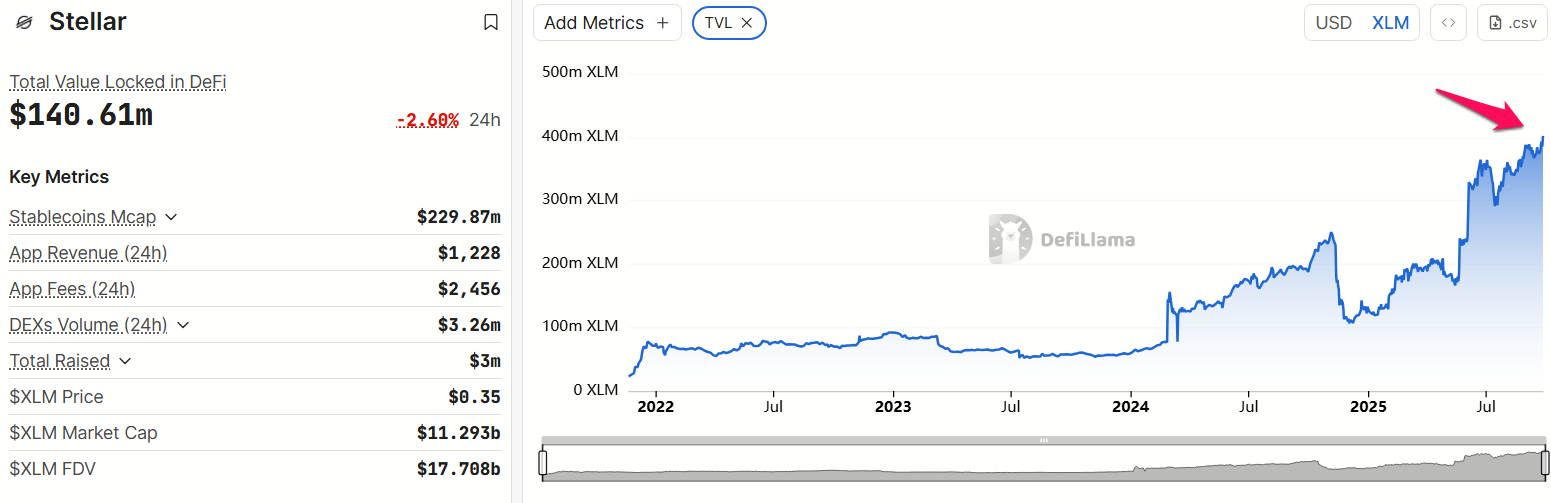
Stellar’s Total Value Locked (TVL) hit a record high in September, with more than 400 million XLM locked in protocols.
Data from DeFiLlama shows that this figure has doubled compared to the previous quarter. The increase reflects the community’s growing confidence in locking XLM within the Stellar ecosystem.
 Stellar’s Total Value Locked. Source:
DefiLlama.
Stellar’s Total Value Locked. Source:
DefiLlama.
TVL calculated in XLM is more reliable than in USD terms. This is because XLM’s USD price fluctuates sharply due to market factors, which can distort the actual picture of assets locked.
In fact, since the beginning of the quarter, XLM’s price has fallen more than 30%, but USD-based TVL has remained stable at around $140 million. The main reason is that the amount of XLM locked in protocols has continued to grow instead of declining.
TVL in XLM focuses on intrinsic value. It accurately measures the assets users commit to staking, lending, or liquidity provision. Leading protocols attracting capital include Blend, Aquarius Stellar, and Stellar DEX.
However, objectively, Stellar’s TVL remains small compared to other ecosystems, where TVL reaches into the billions of USD.
Smart Contract Activity Surged in September
Another highlight for the Stellar network is the sharp increase in smart contract activity.
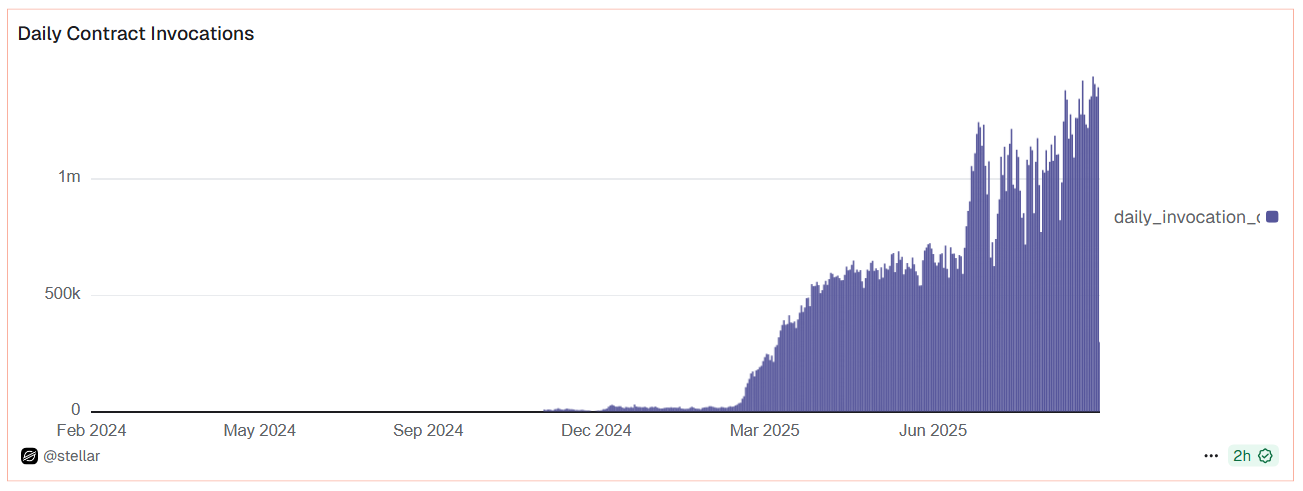
According to Dune Analytics, smart contract operations surged in September, with more than 1 million daily contract invocations.
This metric measures the average number of successful smart contract calls per day. It helps assess adoption trends and informs decisions on resource allocation and platform development.
 Stellar Daily Contract Invocations. Source:
Dune.
Stellar Daily Contract Invocations. Source:
Dune.
The data shows higher transaction volume, greater creativity, and real-world applications from developers. Examples include contracts related to payments, DeFi, or integrations with traditional financial systems.
This surge carries important implications. It proves that Stellar is moving beyond testing phases into real-world adoption. It also strengthens Stellar’s position as a reliable platform for decentralized financial services, attracting more capital and partnerships.
Institutional Interest in Stellar Grew in September
Alongside positive on-chain data, Stellar also expanded its institutional exposure in September.
Mercado Bitcoin, the largest digital asset investment platform in Latin America, recently announced it would issue $200 million worth of tokenized financial assets (stocks and bonds) on the Stellar network.
RedSwan Digital Real Estate also tokenized $100 million of commercial real estate assets (luxury apartments and hotels) on Stellar’s blockchain.
Furthermore, PayPal officially integrated its stablecoin PYUSD on Stellar, enabling fast and low-cost payments.
Notably, the Hashdex Nasdaq Crypto Index US ETF (ticker: NCIQ) filed with the SEC to include NCIQ. The fund consists of five leading crypto assets: Bitcoin (BTC), Ethereum (ETH), XRP, Solana (SOL), and Stellar (XLM).
This move is promising after the SEC eased listing standards for crypto ETFs and officially approved the multi-asset Grayscale Digital Large Cap Fund (GDLC).
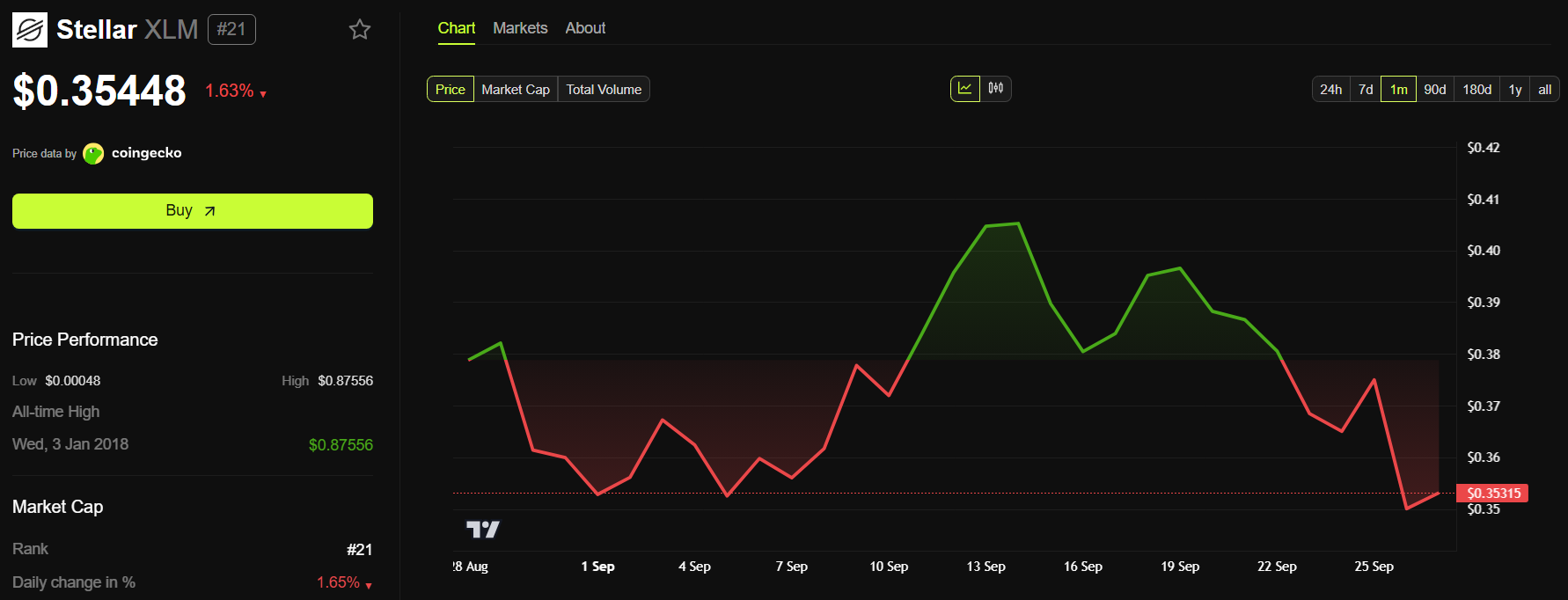
Despite these positive signals, XLM’s price continues to be heavily affected by bearish market sentiment in late September. Once fear-driven trading subsides, Stellar’s strong fundamentals may have the chance to show their value.
Disclaimer: The content of this article solely reflects the author's opinion and does not represent the platform in any capacity. This article is not intended to serve as a reference for making investment decisions.
You may also like
KITE's Price Movement After Listing: Managing Retail REIT Fluctuations in the Context of AI-Influenced Industrial Property Developments
- KITE's Q3 2025 net loss of $16.2M and -$0.07 EPS highlight retail REIT sector challenges despite industrial real estate resilience. - Institutional investors show mixed positioning: Vanguard and JPMorgan sold shares while COHEN & STEERS increased stake by 190.4%. - KITE's indirect AI exposure through logistics partnerships contrasts with peers like Digital Realty , which directly develops AI infrastructure . - The stock's 10% YTD decline reflects market skepticism about its retail-centric model amid $350

The MMT Token TGE: Driving DeFi Advancement and Shaping Investment Approaches in 2025
- Momentum (MMT) launched its TGE on Sui , leveraging CLMM and ve(3,3) models to enhance DeFi efficiency and governance. - The TGE distributed 204.1M tokens, achieving $25B trading volume and $600M TVL within weeks, despite post-launch price volatility. - CLMM optimizes liquidity allocation while ve(3,3) aligns incentives through token locks, addressing DeFi's fragmentation and governance risks. - Investors face balancing long-term staking rewards against market risks, as MMT's success depends on Sui's ado

BTC Chart Shows 3 Major Rejections With a Clear Signal Toward 6% Support

Altcoins on the Edge of Phenomenal Gains — Top 5 High-Risk Plays Targeting 150%+ Upside as Small Caps Rally

Trending news
MoreCrypto prices
More





