
ZKC has dropped by 4003.83% over the past year as both technical factors and market sentiment have worsened.
- ZKC plummeted 4003.83% in a year, triggering technical and sentiment concerns. - Key resistance levels and moving averages remain unbroken, deepening the bearish trend. - Weak RSI/MACD and lack of institutional support erode investor confidence. - A backtesting strategy uses moving averages and volume to capture directional moves amid the downtrend.
ZKC experienced a 14.18% decline over the past day, dropping to $0.5634,
This steep drop has drawn heightened attention to ZKC’s technical performance and overall market sentiment. In recent weeks, ZKC has repeatedly failed to break through important resistance points, deepening its downward trajectory. The token is now trading well below both its 50-day and 200-day moving averages, signaling extended weakness. Market observers and traders have pointed out that ZKC continues to lack stability, with bearish signals from indicators such as RSI and MACD persisting in negative zones.
The recent price movement has also been characterized by minimal support from short-term buyers. Although there have been sporadic recovery attempts, ZKC has struggled to hold gains above significant psychological thresholds. This ongoing weakness has further eroded investor trust and increased caution across the market. Institutional participation has remained low, adding to the absence of a clear price trend.
Backtesting Strategy Hypothesis
An outlined backtesting approach for ZKC relies on its latest technical trends, utilizing a mix of moving averages and volume metrics to identify trading opportunities. This method favors long trades only when ZKC rises above its 200-day moving average accompanied by higher trading volume, while short trades are initiated if the price drops below crucial support levels confirmed by RSI divergence. The strategy seeks to capture price movements during the ongoing downtrend by combining trend-following and mean-reversion signals. Risk controls are built in, with stop-losses set at 7% and a cap of 5% of the portfolio allocated to any single position.
Disclaimer: The content of this article solely reflects the author's opinion and does not represent the platform in any capacity. This article is not intended to serve as a reference for making investment decisions.
You may also like
Fed Cuts Rates, Announces $40B T-Bill Program, Crypto Dips
U.S. Marine Policy and Blue Economy Prospects: Key Infrastructure and Geostrategic Roles in Oceanic Commerce
- U.S. oceans policy balances geopolitical strategy, deep-sea tech investments, and UNCLOS ratification challenges to secure maritime influence. - Executive actions accelerate seabed mineral extraction while facing environmental criticism and legal risks from bypassing international seabed authority rules. - Offshore energy partnerships with Australia, Japan, and Saudi Arabia aim to diversify supply chains but face geopolitical tensions in chokepoints like the Red Sea. - Maritime security contracts expand

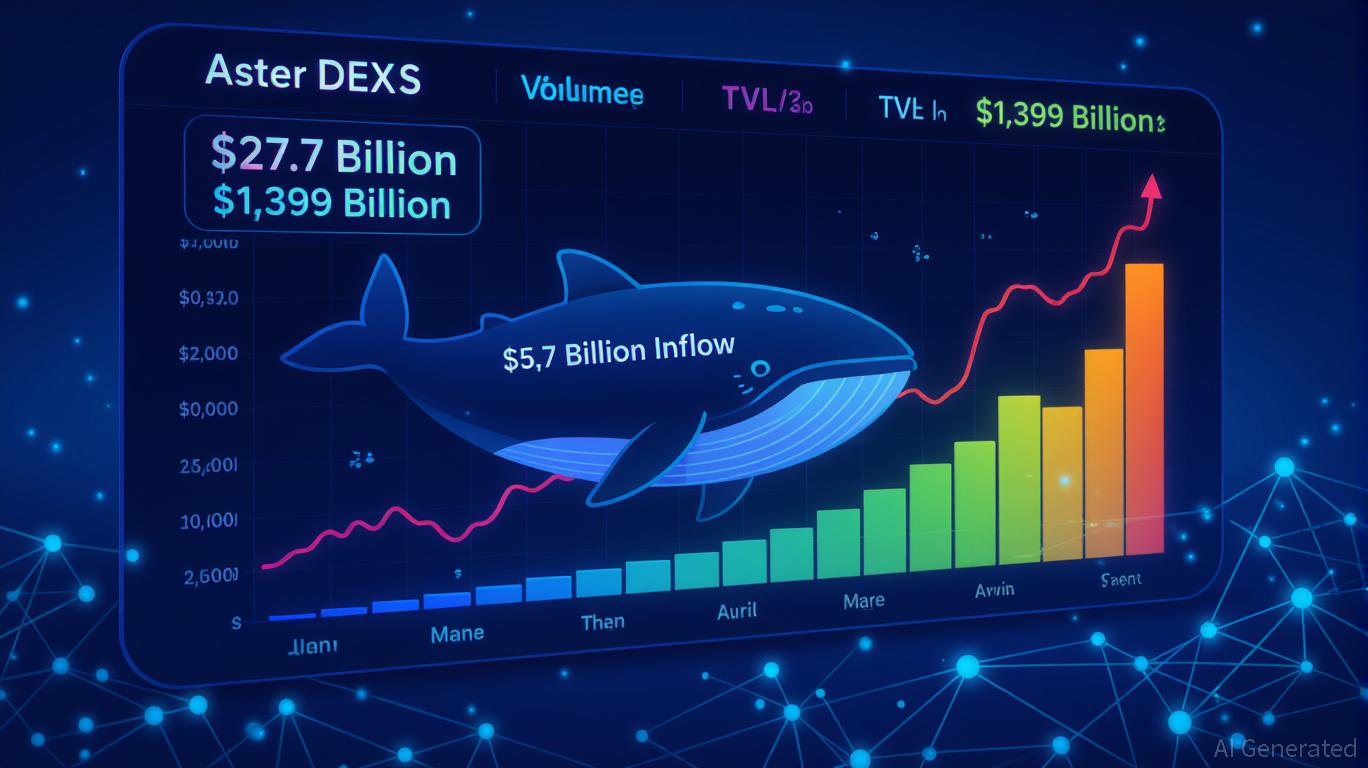
Aster DEX's On-Chain Momentum: Signaling the Future of DeFi
- Aster DEX reported $27.7B daily volume and $1.399B TVL in Q3 2025, outpacing DeFi benchmarks with 2M users. - Institutional whale activity, including CZ's $2M ASTER purchase, drove $5.7B inflows and 800% volume spikes. - Hybrid AMM-CEX model and ZKP privacy tech enabled 40.2% TVL growth, 77% private transactions, and 19.3% perpetual DEX market share. - ASTER's margin trading upgrades and Stage 4 airdrops fueled 30% price surges, while Aster Chain's 2026 launch will integrate privacy-preserving ZKPs. - On
Astar (ASTR) Price Rally: Protocol Enhancements and Ecosystem Growth Drive Long-Term Value
- Astar (ASTR) surged 150% due to protocol upgrades and ecosystem expansion, positioning it as a sustainable value creation case study in blockchain. - Tokenomics 3.0 (fixed 10.5B supply) and Burndrop mechanism created deflationary incentives, supported by Galaxy Digital's $3. 3M OTC investment and Astar's $29.15M buyback. - Cross-chain interoperability with Polkadot/Plaza and Sony's Soneium, plus partnerships with Toyota and Japan Airlines, expanded real-world utility in logistics, identity, and loyalty p
Trending news
MoreCrypto prices
More





