
Datavault's Bold Bitcoin Supercomputer Bet: Will AI Excitement Surpass Economic Challenges?
- Datavault AI's stock surged 23% after announcing a $150M Bitcoin investment to build an HPC supercomputer for AI development. - The move follows strategic acquisitions and IBM partnerships to enhance AI tools like DataScore, targeting financial modeling and risk analytics. - Despite 467% revenue growth and $25M run-rate projections, the firm faces $68.6M losses, high short interest, and execution risks from crypto volatility. - Analysts highlight the gamble's success depends on supercomputer efficiency a

Shares of Datavault AI soared by 23% in after-hours trading after the company revealed a $150 million
The capital will support the development of a supercomputing platform to advance Datavault’s AI offerings, including its leading AI agents DataScore and DataValue. These solutions, which saw enhancements in July 2025, are designed for enterprise-level financial modeling, risk evaluation, and pricing analysis. Datavault’s strategic shift toward AI-powered data management has been strengthened by collaborations with IBM and Burke Products, as well as acquisitions in audiovisual, IT services, and event analytics sectors [2]. IBM’s decision to include
Recent financial results highlight Datavault’s rapid growth. The company posted a 467% year-over-year revenue jump to $1.7 million in the latest quarter, fueled by recurring income from AI products and acquisitions. Management anticipates reaching a $25 million run rate by the end of 2025 and projecting $40–50 million in annual revenue for 2026. These projections are in line with two analyst “Buy” ratings and a consensus price target of $7 per share, implying a potential 1,450% increase from current prices [3]. Nevertheless, the company has yet to achieve profitability, reporting a net loss of $68.61 million over the past twelve months and seeing short interest rise by more than two-thirds in the previous month [1].
This Bitcoin investment marks Datavault’s first foray into using cryptocurrency reserves for capital projects. With a market cap of $53 million, the addition of Bitcoin—currently valued at about $150 million—could help the company compete in the HPC arena. This strategy reflects a broader industry trend, as AI firms increasingly turn to alternative funding sources to expand infrastructure. Analysts emphasize that the outcome will depend on the supercomputer’s operational performance and Datavault’s ability to generate revenue from its AI solutions in a competitive landscape [3].
Significant risks persist. Datavault’s dependence on volatile markets and its penny stock status, with a 52-week trading range between $0.25 and $2.68, make it a highly speculative investment. The stock has been heavily shorted, and its return on equity stands at -144.42%, underscoring ongoing financial headwinds. Still, recent acquisitions—such as API Media Innovations in audiovisual and CompuSystems in event analytics—indicate a strategy to diversify revenue sources [2].
The market’s response highlights strong investor interest in innovative AI companies that are not widely followed. Datavault’s collaboration with Burke Products to create secure identity verification solutions for military service claims further broadens its product lineup. Together with the Bitcoin-funded supercomputer initiative, these efforts could establish Datavault as a specialized provider of enterprise AI solutions. However, analysts warn that challenges such as regulatory issues related to cryptocurrency holdings and potential delays in supercomputer deployment could hinder long-term progress [3].
Disclaimer: The content of this article solely reflects the author's opinion and does not represent the platform in any capacity. This article is not intended to serve as a reference for making investment decisions.
You may also like
Fed Cuts Rates, Announces $40B T-Bill Program, Crypto Dips
U.S. Marine Policy and Blue Economy Prospects: Key Infrastructure and Geostrategic Roles in Oceanic Commerce
- U.S. oceans policy balances geopolitical strategy, deep-sea tech investments, and UNCLOS ratification challenges to secure maritime influence. - Executive actions accelerate seabed mineral extraction while facing environmental criticism and legal risks from bypassing international seabed authority rules. - Offshore energy partnerships with Australia, Japan, and Saudi Arabia aim to diversify supply chains but face geopolitical tensions in chokepoints like the Red Sea. - Maritime security contracts expand

Aster DEX's On-Chain Momentum: Signaling the Future of DeFi
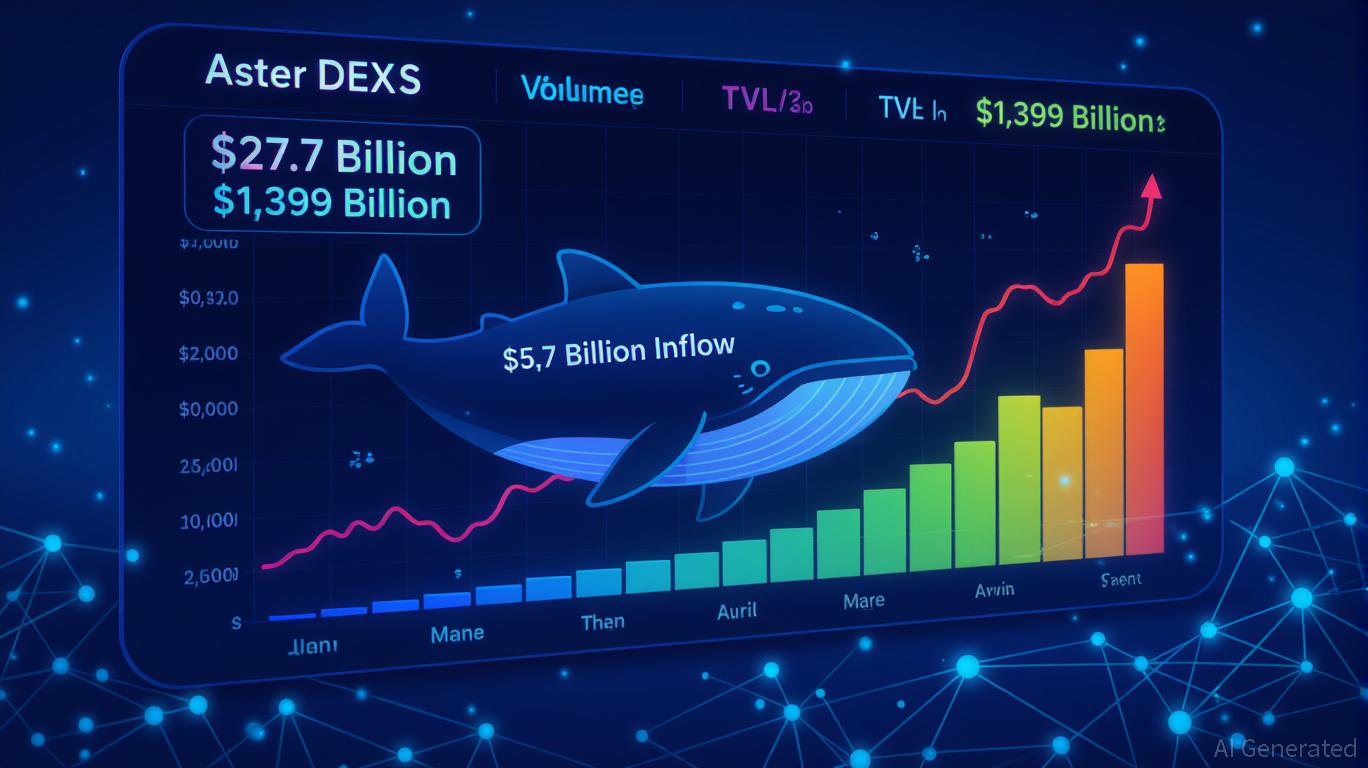
- Aster DEX reported $27.7B daily volume and $1.399B TVL in Q3 2025, outpacing DeFi benchmarks with 2M users. - Institutional whale activity, including CZ's $2M ASTER purchase, drove $5.7B inflows and 800% volume spikes. - Hybrid AMM-CEX model and ZKP privacy tech enabled 40.2% TVL growth, 77% private transactions, and 19.3% perpetual DEX market share. - ASTER's margin trading upgrades and Stage 4 airdrops fueled 30% price surges, while Aster Chain's 2026 launch will integrate privacy-preserving ZKPs. - On
Astar (ASTR) Price Rally: Protocol Enhancements and Ecosystem Growth Drive Long-Term Value
- Astar (ASTR) surged 150% due to protocol upgrades and ecosystem expansion, positioning it as a sustainable value creation case study in blockchain. - Tokenomics 3.0 (fixed 10.5B supply) and Burndrop mechanism created deflationary incentives, supported by Galaxy Digital's $3. 3M OTC investment and Astar's $29.15M buyback. - Cross-chain interoperability with Polkadot/Plaza and Sony's Soneium, plus partnerships with Toyota and Japan Airlines, expanded real-world utility in logistics, identity, and loyalty p

Trending news
MoreCrypto prices
More





