
Bankless: Will Trump Promote the "Nationalization" of Crypto Infrastructure?

Source: Bankless
Author: Jack Inabinet
Compiled and organized by: BitpushNews

"Trump's brand of American capitalism faces 'socialist' backlash from conservatives" — BBC
"Republican senators sound alarm over Donald Trump's 'socialist step'" — Newsweek
"Investors worry Trump's Intel deal ushers in an era of U.S. industrial policy" — Reuters
These recent headlines seem to capture the unease among business leaders, who are shocked to witness the U.S. federal government acquiring a 10% stake in Intel.
Although this move has split opinions within the party, drawing rare criticism from staunch conservatives while winning applause from the more socialist-leaning camp, one thing is clear: The script of American laissez-faire capitalism is being rewritten in real time.
During his second term, President Trump has clashed with free-market conservatives at least twice. In June this year, his administration approved the acquisition of U.S. Steel by Japan's Nippon Steel, but only on the condition that Washington receives a "golden share," granting broad governance rights over the American subsidiary.
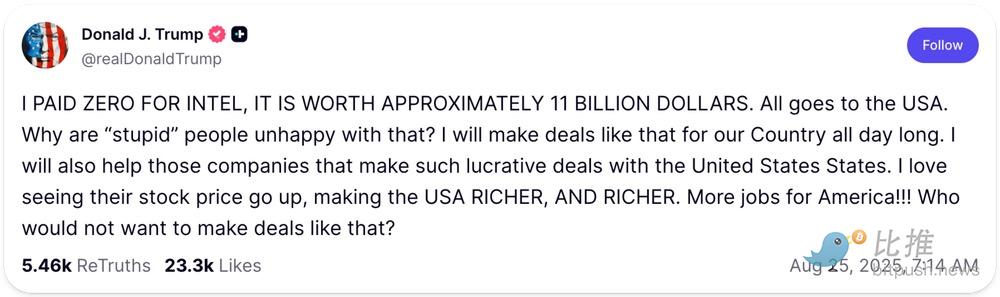
Intra-party criticism may be a rare phenomenon in U.S. politics, but Trump has shown little concern for this round of conservative condemnation, declaring to his followers on Truth Social on Monday that he would make similar deals "all day long."
In a comment to The Hill, an anonymous Republican strategist defended Trump's takeover of companies like U.S. Steel and Intel, arguing that the move was justified because their output is "crucial to U.S. defense needs and national security."
When I think of cryptocurrency…
Although the U.S. government's current cryptocurrency holdings mainly come from criminal assets seized by law enforcement, if the Intel case is any indication, such acquisitions cannot yet be ruled out.
Since the beginning of his campaign, Donald Trump has promised to make clarity on cryptocurrency a policy priority. Early achievements of the Trump administration include:
-
Enacting the GENIUS Act to pave the way for the widespread adoption of mainstream stablecoins
-
Establishing a strategic cryptocurrency reserve to safeguard government-held digital assets
-
Revitalizing the SEC through dedicated cryptocurrency task forces and "crypto projects"
-
Dismissing major pending regulatory actions against cryptocurrency companies
Insiders in the Trump administration have long insisted on a "budget-neutral" approach to expanding federal crypto asset holdings, and the Intel acquisition seems to set a precedent for such purchases.
As the only cutting-edge chip manufacturer in the U.S., Intel plays a key role in securing America's digital future. Through this framework, the federal government may wish to protect the nation's best interests by holding Intel shares, such as guiding production priorities or prohibiting undesirable actions (like divesting loss-making chip foundries).
The acquisition of Intel was "funded" by allocations from the Biden-era CHIPS Act. While the funds allocated by this program undoubtedly cost taxpayers money, the money was originally intended for semiconductor R&D, meaning the government's Intel equity is technically "free."
The modernization of currency has long been imperative, just as computer chips have made critical contributions to contemporary society. Blockchain-based payments are sure to play an important role in the next generation of financial systems.
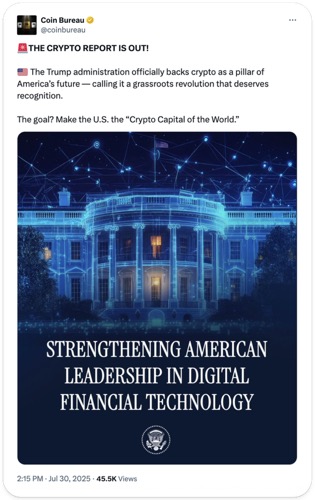
The passage of the GENIUS Act highlights that this fact has gained bipartisan recognition. Although any progress in Washington, D.C. is notoriously slow, future legislation could well authorize spending on grant programs aimed at strengthening blockchain payment systems.
Such a critical payment network would naturally be classified as vital to U.S. national security, and given the precedent set by the Intel deal, these grants could be seen as consideration for obtaining token rights in the network.
Therefore, the only real question now is which crypto asset Washington will choose to embrace. Will the U.S. consolidate its position as the world's largest national bitcoin holder, or will it choose another network as the pillar of its digital economy?
Regardless of the outcome, the precedent has been set: the U.S. government is no longer just a regulator of high technology—it is becoming an active market participant.
Disclaimer: The content of this article solely reflects the author's opinion and does not represent the platform in any capacity. This article is not intended to serve as a reference for making investment decisions.
You may also like
Stablecoin Legislation Booms Globally, Why Is China Taking the Opposite Approach? An Article to Understand the Real National Strategic Choices
Amid the global surge in stablecoin legislation, China has chosen to firmly curb stablecoins and other virtual currencies, while accelerating the development of the digital yuan to safeguard national security and monetary sovereignty. Summary generated by Mars AI. This summary is produced by the Mars AI model and its accuracy and completeness are still being iteratively improved.
Liquidity migration begins! Japan becomes the Fed's "reservoir," 120 billions in carry trade returns set to ignite the December crypto market
The Federal Reserve has stopped quantitative tightening and may cut interest rates, while the Bank of Japan plans to raise rates, changing the global liquidity landscape and impacting carry trades and asset pricing. Summary generated by Mars AI. This summary is produced by the Mars AI model, and the accuracy and completeness of its content are still under iterative improvement.

Weekly Hot Picks: Bank of Japan Sends Strongest Rate Hike Signal! Is the Copper Market Entering a Supercycle Rehearsal?
The leading candidate for Federal Reserve Chair is being questioned for potentially "accommodative rate cuts." Copper prices have reached a historic high, and a five-hour meeting between the United States and Russia ended without results. Expectations for a Japanese interest rate hike in December have surged, and Moore Threads' stock soared more than fivefold on its first day... What market moves did you miss this week?
Monad Practical Guide: Welcome to a New Architecture and High-Performance Development Ecosystem
This article will introduce some resources to help you better understand Monad and start developing.
Trending news
MoreCrypto prices
More





