
Hong Kong Sandbox plans to focus on the Bund conference, and RWA becomes a new theme for China's Web3?
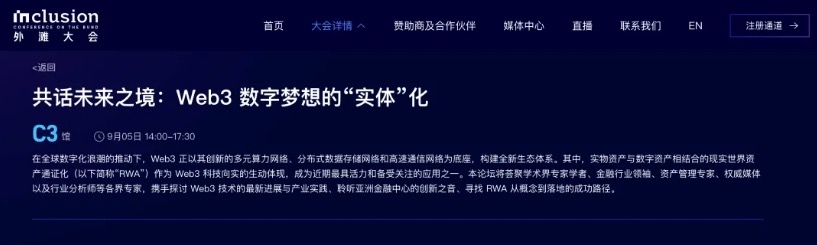
- Longxin Group Chairperson Xu Changjun delivered a keynote speech titled "Exploring the'New 'Trajectory of Investment and Unleashing the'Energy' of New Energy".
- ZAN CEO Zhang Chenguang delivered a keynote speech on "Exploration and Practice of DT RWA Empowering New Energy Industry in the VUCA Era".
- Xiao Gang, a member of the 13th National Committee of the Chinese People's Political Consultative Conference and former chairperson of the China Securities Regulatory Commission, delivered a speech titled "New Power of Financial Technology, New Engine of Digital Economy".
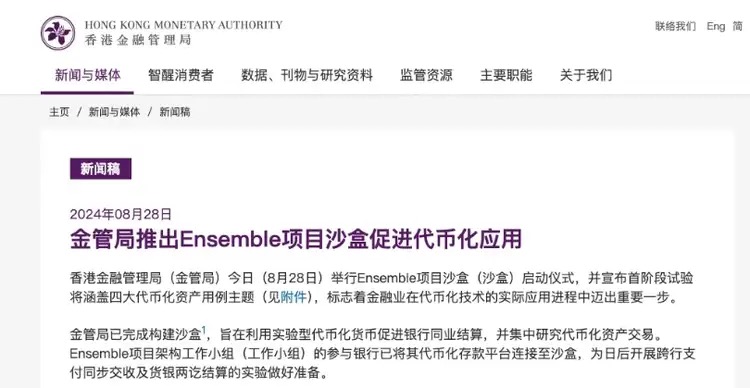
- Explore application scenarios: Allow participants to experiment with tokenized assets in a secure environment and explore various applications without immediately facing the pressure of full implementation.
- Technical Testing: Testing the compatibility between different digital assets, tokenized deposits, and CBDC. This stage is crucial to ensure the robustness of the technology and prepare for wider adoption.
- Establish industry standards: Establish common industry benchmarks for tokenization, which is crucial for the development of technology. By facilitating the entire lifecycle of tokenized asset transactions from creation to transaction to payment and settlement, Sandbox helps participants understand the actual impact of tokenization and its potential to solve real-world challenges, such as its application in supply chain financing.
- Solving real-world challenges: Sandbox promotes innovative applications aimed at solving practical problems in the financing field, especially in areas such as trade and supply chain finance. By addressing these pain points, Ensemble is helping to make tokenization a viable option for enterprises.
- Fixed Income and Mutual Funds: This topic explores how tokenization is changing traditional investment tools, making them more accessible and efficient. By creating digital representations of bonds or Mutual Funds, the financial industry can reduce settlement time, lower costs, and enhance liquidity, providing new opportunities for investors.
- Liquidity Management: Tokenization has the potential to revolutionize liquidity management by allowing assets to be split and traded on digital platforms. This could lead to more dynamic and efficient liquidity management, especially where quick access to funds is critical.
- Green and Sustainable Finance: The MAS also focuses on how tokenization can support green and sustainable finance initiatives. By tokenizing assets such as green bonds or carbon credits, the financial sector can enhance transparency and traceability, ensuring that funds are effectively allocated to environmental projects.
- Trade and Supply Chain Finance: Tokenization can solve major pain points in trade and supply chain finance by simplifying the process of tracking and transferring ownership of goods and financial assets. This can improve the efficiency and transparency of the supply chain, reduce fraud risks, and enhance overall market confidence.
- Enhance liquidity. Traditional real-world assets like real estate tend to be illiquid, meaning they can be difficult to sell quickly. Tokenization allows these assets to be split into smaller tokens that are easier to trade, improving liquidity.
- Increase accessibility. Tokenization makes asset classes that were previously inaccessible to many investors more widely accessible. For example, people with limited capital can purchase a small portion of high-value assets (such as real estate) through tokens.
- Reduce transaction costs. Blockchain technology can reduce the cost of trading and transferring assets as it eliminates the need for intermediaries such as brokers or custodial agents.
Disclaimer: The content of this article solely reflects the author's opinion and does not represent the platform in any capacity. This article is not intended to serve as a reference for making investment decisions.
You may also like
Key Bitcoin price levels to watch ahead of 2025’s last FOMC meeting
Navigating the Fluctuations of Bitcoin in Late 2025: Adaptive Risk Management Approaches for an Evolving Cryptocurrency Landscape
- Bitcoin's November 2025 price swung between $80,553 and $91,000, eroding 25% of value amid macroeconomic and regulatory pressures. - Volatility stemmed from technical breakdowns, leveraged liquidations, and market makers' gamma exposure shifts below $85,000. - U.S. GENIUS Act and EU MiCA framework provided regulatory clarity, boosting institutional adoption through compliant ETPs and stablecoins. - Investors adopted risk-rebalance strategies: options hedging, macro-adjusted DCA, and diversified crypto tr
Bitcoin Experiences Steep Drop: What Causes the Sudden Sell-Off?
- Bitcoin plummeted 30% in November 2025, erasing $1 trillion in market cap amid macroeconomic pressures and institutional profit-taking. - Central bank uncertainty (Fed, ECB) and leveraged liquidations amplified the selloff, with ETF outflows exceeding $3.79 billion. - Bitcoin's 0.90 correlation with the S&P 500 highlighted its shift from "digital gold" to risk-on asset, contrasting gold's 55% surge. - On-chain metrics revealed structural weaknesses: hash rate declines, miner revenue drops, and divergent

PENGU USDT Sell Alert and Stablecoin Price Fluctuations: Evaluating Algorithmic Dangers Amid Changing Cryptocurrency Markets
- PENGU USDT's 2025 volatility reignited debates on algorithmic stablecoin fragility amid regulatory uncertainty and post-UST market skepticism. - Technical analysis showed conflicting signals: overbought MFI vs bearish RSI divergence, with critical support/resistance levels at $0.010-$0.013. - $66.6M team wallet outflows and 32% open interest growth highlighted liquidity risks, while UST's collapse legacy exposed algorithmic design flaws. - Investors increasingly favor fiat-backed alternatives like USDC ,
Trending news
MoreCrypto prices
More





